
Why do muscles get tight, and why stretching does not make them longer
Written by Sean Goldberg, who qualified as a physiotherapist in Australia and is a clinical Pilates instructor and the lead teacher at Samasti Yoga. Published 6 September 2026.
Your hamstrings are almost certainly the same length they were when you were twenty. They feel tight because your nervous system has decided how far it will let you go, and it makes that decision on feel rather than on the length of the tissue. When a few weeks of stretching makes you more flexible, the muscle has not got longer. Studies that follow people through six or eight weeks of daily stretching find the muscle and tendon unchanged; what changes is how much stretch a person can tolerate before the body says stop. That is the short answer. The rest of this article is a test you can do in one minute that shows it in your own body, the mechanism behind it, where the research is still arguing, and what it changes about how a stretch is held and how it is cued.
The common perception is that a tight muscle is a short muscle, and holding a stretch will make it longer. It is still what most people are taught, and it is a reasonable thing to believe, because it matches what stretching feels like. It is also, as far as the research can tell, mostly wrong.
The one minute test
Stand up and fold forward with your knees as straight as is comfortable for you. Notice where your hands reach. Your shins, the floor, one knuckle, your flat palm. That is your starting point.
Now take a tennis ball, or a spiky ball if you have one, and stand on it with one foot. Press firmly through your arch, not your heel and not the ball of your foot, and hunt for the sore spots for thirty seconds. Change feet. Then fold forward again.
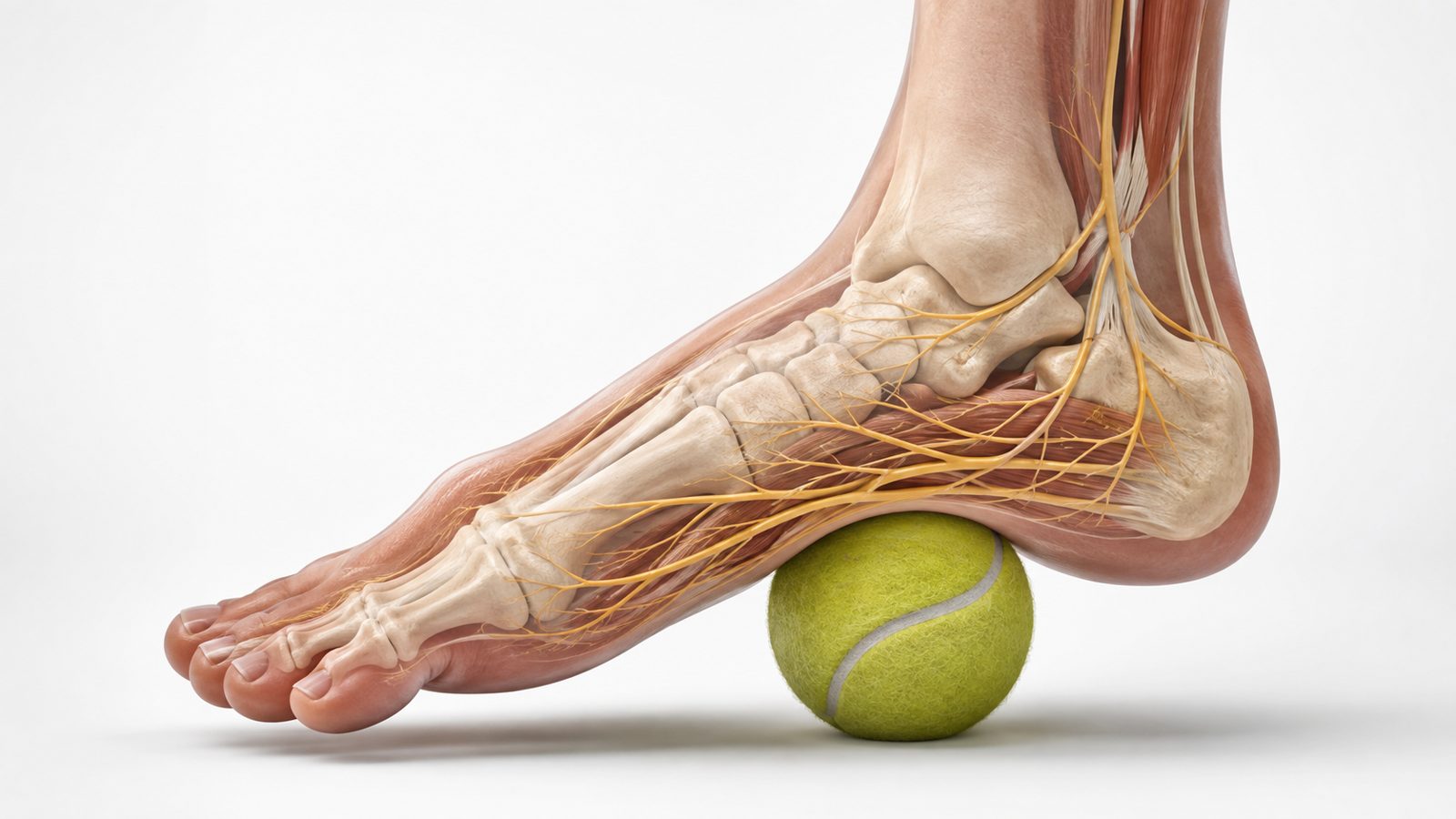
Almost everybody gets further, and the difference is not small. I do this in the anatomy labs on every training and it is still one of the moments that gets the biggest reaction in the room. So the question is what changed. The hamstrings were never touched. Nothing at the back of the leg was stretched, pressed or warmed. In one minute, muscle tissue does not get longer. Something else moved the limit, and the rest of this article is about what that something is.
What tightness actually is
A muscle has two kinds of tension in it. The first is passive, and it comes from the structure of the muscle itself and the connective tissue wrapped around it. Scarring adds to it, and so does a joint that has been held in one position for a long time, the way a leg in a cast comes out with less flexibility than it went in with. The second kind is active, and it comes from the nervous system. A muscle is never fully switched off. There is always a low level of activity in it, set and adjusted from moment to moment by reflexes that run through the spinal cord, and that background activity is a large part of what tightness feels like.
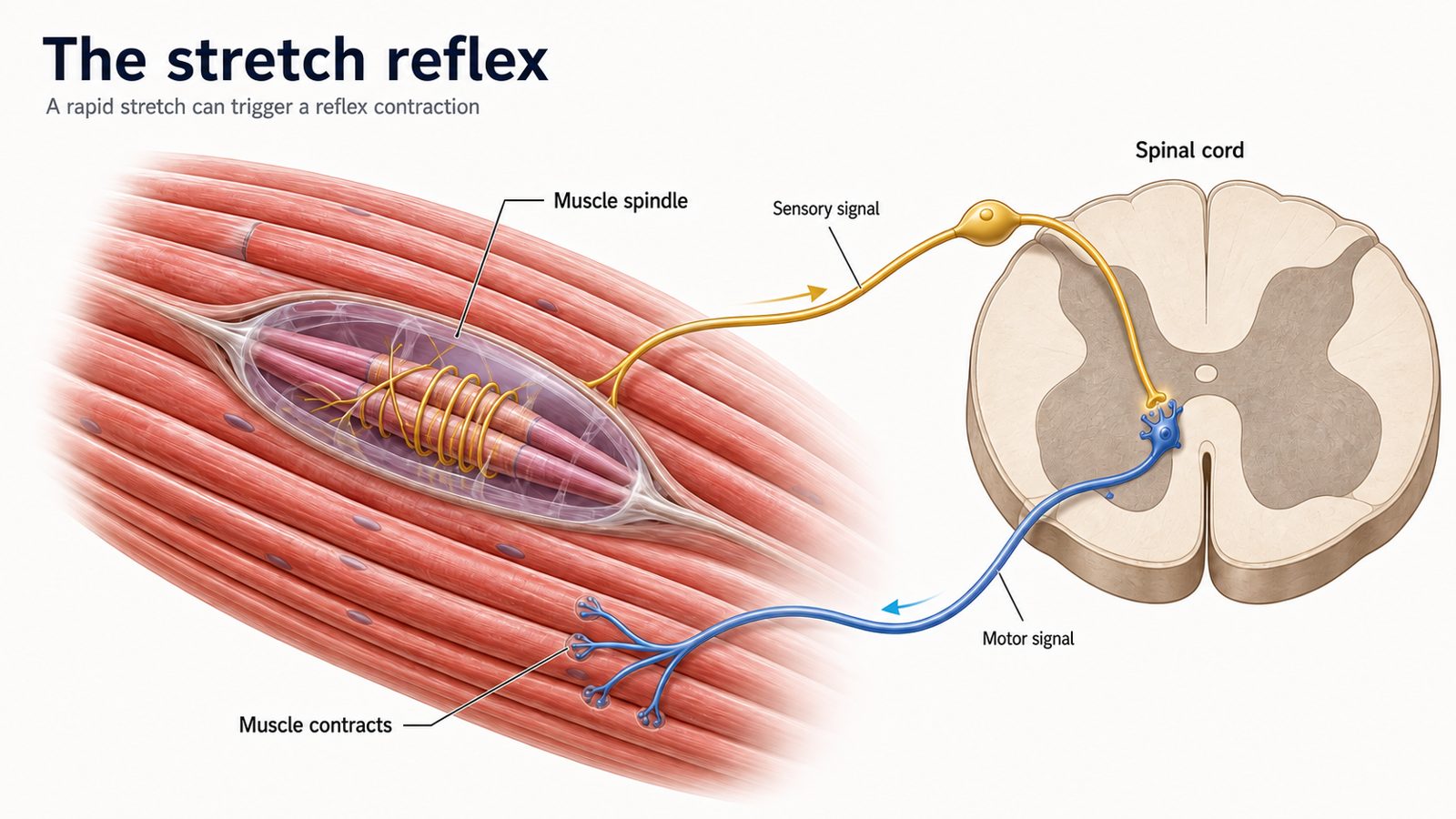
Inside every muscle there are small sensors called muscle spindles. They report the length of the muscle and, more importantly, how fast that length is changing. If a muscle is stretched suddenly, the spindle fires and the muscle contracts to protect itself. That is the stretch reflex, and it is the reason a tap below the kneecap makes the leg kick. It is also the reason a fast or bouncing stretch gets less range, because the muscle you are trying to lengthen is being told to contract at the same moment.
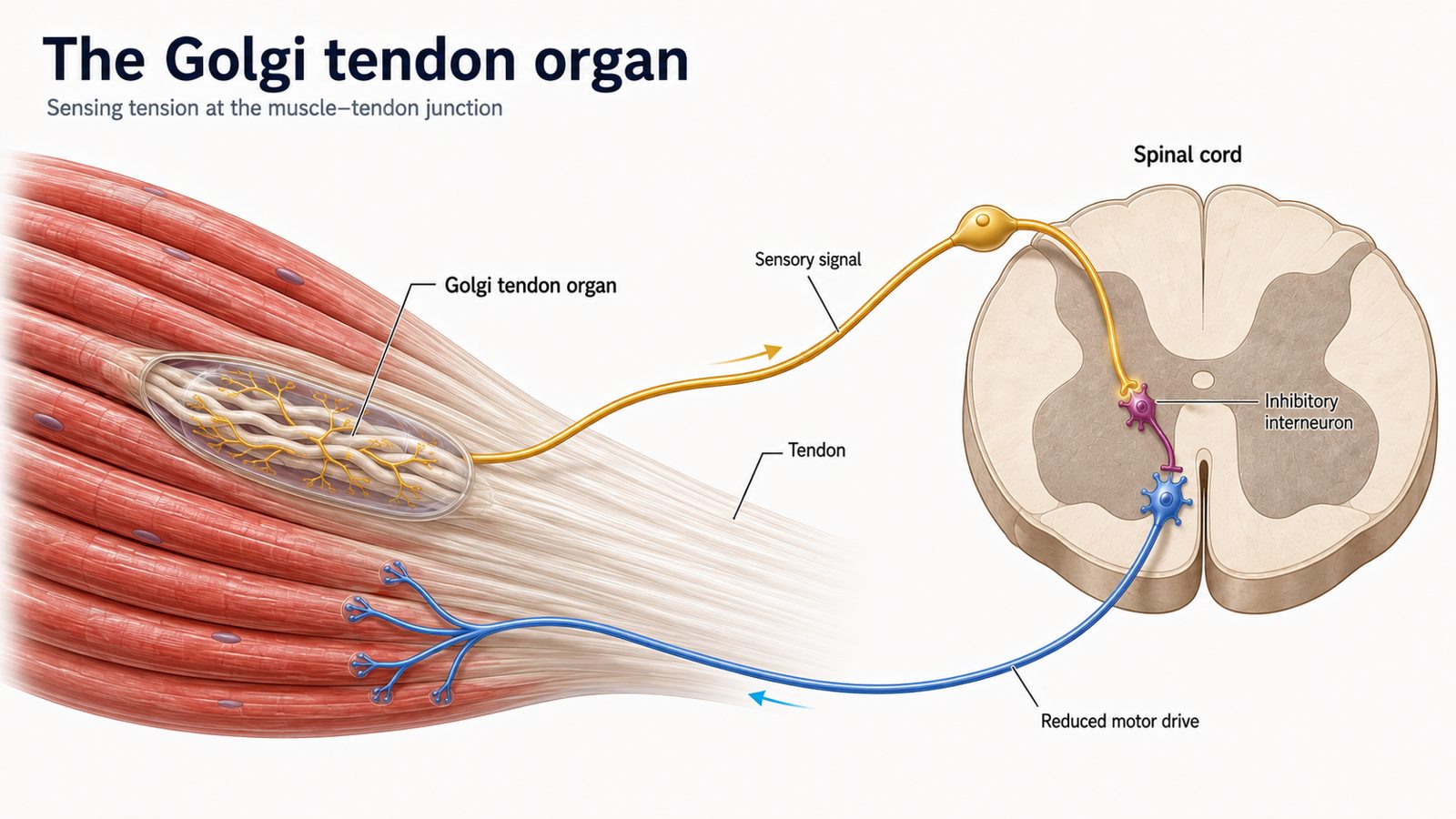
At the other end of the muscle, where it joins the tendon, are sensors called Golgi tendon organs. They measure tension rather than length, and when tension gets high enough they do the opposite job to the spindles and tell the muscle to let go. They are more sensitive than we used to think, and they are the usual explanation for why a strong contraction held for several seconds is followed by a muscle that is easier to stretch, and I will come back to that. Anybody who has done contract and relax stretching, the method usually called PNF, for proprioceptive neuromuscular facilitation, has used them, whether they knew it or not.
So a muscle is being monitored continuously for length, speed and tension, and the nervous system is adjusting its tone continuously in response. When you stretch, that is the system you are negotiating with. As I see it, the feeling of tightness is mostly that negotiation, and only a small part of it is the actual muscle length.
What a few weeks of stretching actually changes
This is the part where the research is clear.
A review of stretching studies lasting three to eight weeks found that the muscle and tendon did not change their mechanical properties. They were not longer and they were not less stiff. Range of motion improved, and it improved because the person could tolerate a greater stretching force before they reached the point where they stopped. The authors described the adaptation as happening mostly at a sensory level. A second, larger analysis of nineteen studies and 467 people looked directly at muscle structure with ultrasound and found a trivial increase in the length of the muscle fibres at rest. When the studies were split, the increase came only from those that pushed to the point of discomfort or beyond, week after week. The studies that stretched below discomfort, however long they held, found no change at all.
In plain terms, when you become more flexible over a month of practice, your hamstrings are the same length they were. What has changed is where your nervous system draws the line.
I want to be fair to the other side of this. Push into discomfort for months and there are small structural changes as well, and a joint held still for long enough does adapt, as the cast example shows. So it is not that tissue never changes. It is that tissue change is slow and small, it comes from the kind of stretching I am about to tell you not to do, and it is not what the first weeks of progress are made of.
The brakes
The image I use for this in the training is a set of brakes. The nervous system decides how far it will let a joint go before it limits movement, and it makes that decision on feel. The signal to stop arrives well before anything is at risk of tearing, because that is what a safety system is for. It is set to be cautious, and it is not always accurate.
A muscle that has not been taken near its end range for a long time has brakes that come on early. As far as the nervous system knows, that range is unfamiliar, and unfamiliar means dangerous. Nothing has to be wrong with the tissue for that to be true. A person who sits all day has hamstrings that are, in all likelihood, exactly the length they were at twenty. What they have is a nervous system that has not been shown the end of that range in a long time and no longer trusts it.
What resets the brakes is going there often. Each time a muscle is taken to its edge and nothing bad happens, the nervous system learns that the range is safe, and it lets the brakes off a little later next time. My reading is that this is most of what a regular stretching practice is doing. It is not lengthening anything. It is teaching the nervous system, through repetition, that a range it was guarding does not need to be guarded.
I suspect this is also why contract and relax works as well as it does. The textbook explanation is the tension sensors, but their effect lasts under a second, and what a strong contraction at the edge of a range really does is show the nervous system that you can still produce force there, and a range you are strong in is a range it does not need to guard. Strength training through a full range improves flexibility about as well as stretching does, which points the same way.
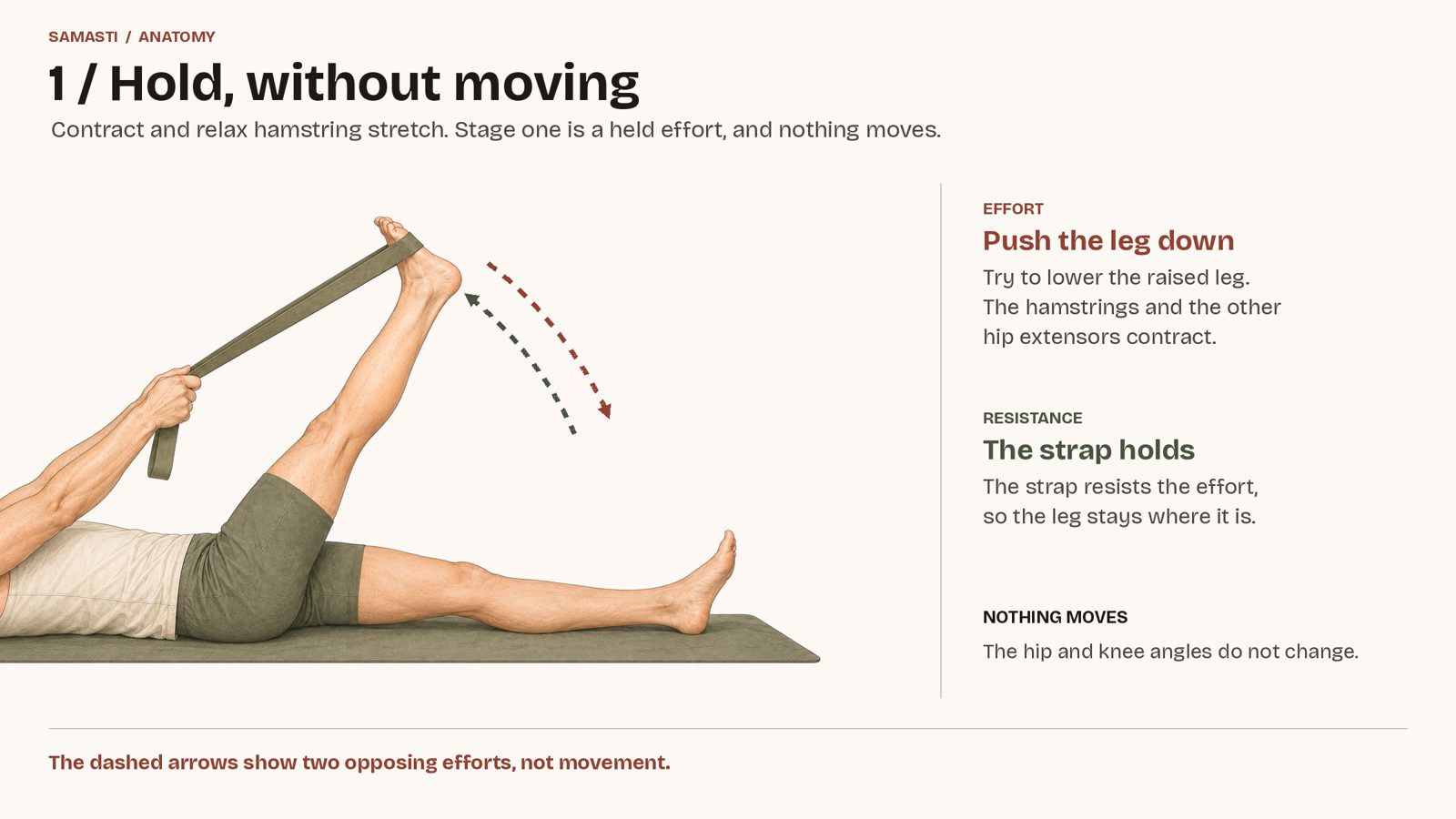
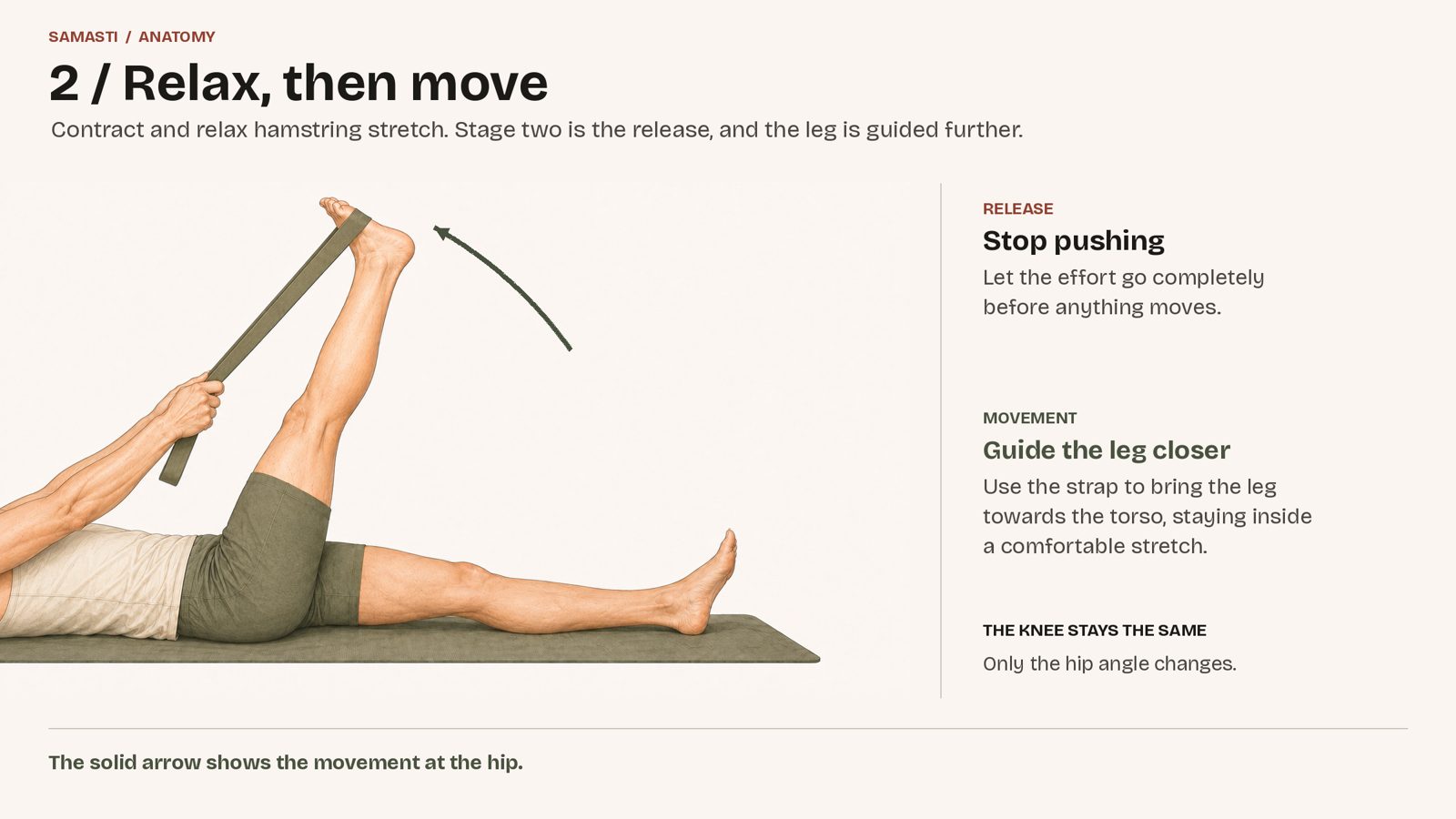
That also explains why pushing into pain gets less range, not more. Pain is the brakes starting to come on. The muscle guards, because guarding is its job, and the harder you push against it the harder it holds. The things that experienced teachers have always said about stretching, move into the pose slowly, use a long exhale to allow rather than push, the attention resting on the muscle being stretched, are essential for safety of the body and respect to the nervous system. Each of them is a way of keeping the spindles quiet and the nervous system calm enough to let go. A slow entry does not trigger the stretch reflex. A long exhale nudges the body towards its rest state. Attention on the muscle gives the brain the information it needs to decide that this is safe.
Why the foot changes the hamstrings
Now back to the test, because the honest answer is that people have studied it and they do not agree on why it works.
The effect itself is real and it has been reproduced. A small trial in 2015 rolled the soles of the feet and measured hamstring flexibility before and after, and found it improved. A larger trial in 2021, with 94 people, rolled one of five different places along the back of the body for ten minutes each, from the sole of the foot to the fascia over the back of the skull, and measured hamstring flexibility and ankle range afterwards. Every one of them improved both. Half of the gain occurred inside the first two minutes.
The popular explanation is a fascial one, usually made by the people I jokingly call “fascial fascists” because they attribute everything to the fascia. The connective tissue on the sole of the foot is continuous with the tissue up the back of the calf, the hamstrings, the back and the skull, a line that has been named the superficial back line, and the idea is that releasing one segment of the line changes the whole of it. The authors of the 2021 trial concluded that the line behaves as a functional unit, and to be fair to them, they found that different segments produced different sizes and speeds of effect, which is what you would expect if the tissue itself mattered.
I do not find the fascial explanation convincing, and I should be clear that this is my position rather than a settled one. The same authors offered a second explanation alongside the first, which is that a strong mechanical stimulus anywhere sets off a chain of events in the spinal cord and brain that changes muscle tone at a distance. And there is a study that makes the neural version hard to dismiss. In 2021 a group in Japan rolled one calf only, three bouts of a minute, and measured both legs. Ankle range improved by 20 percent in the rolled leg and by 14 percent in the untouched leg. They also measured the stiffness of the muscle directly with ultrasound and found no change in either leg, and they measured the excitability of the spinal reflex and found no change in that either. Their conclusion was that the range came from a sensory change, in both legs, and not from anything happening in the tissue.
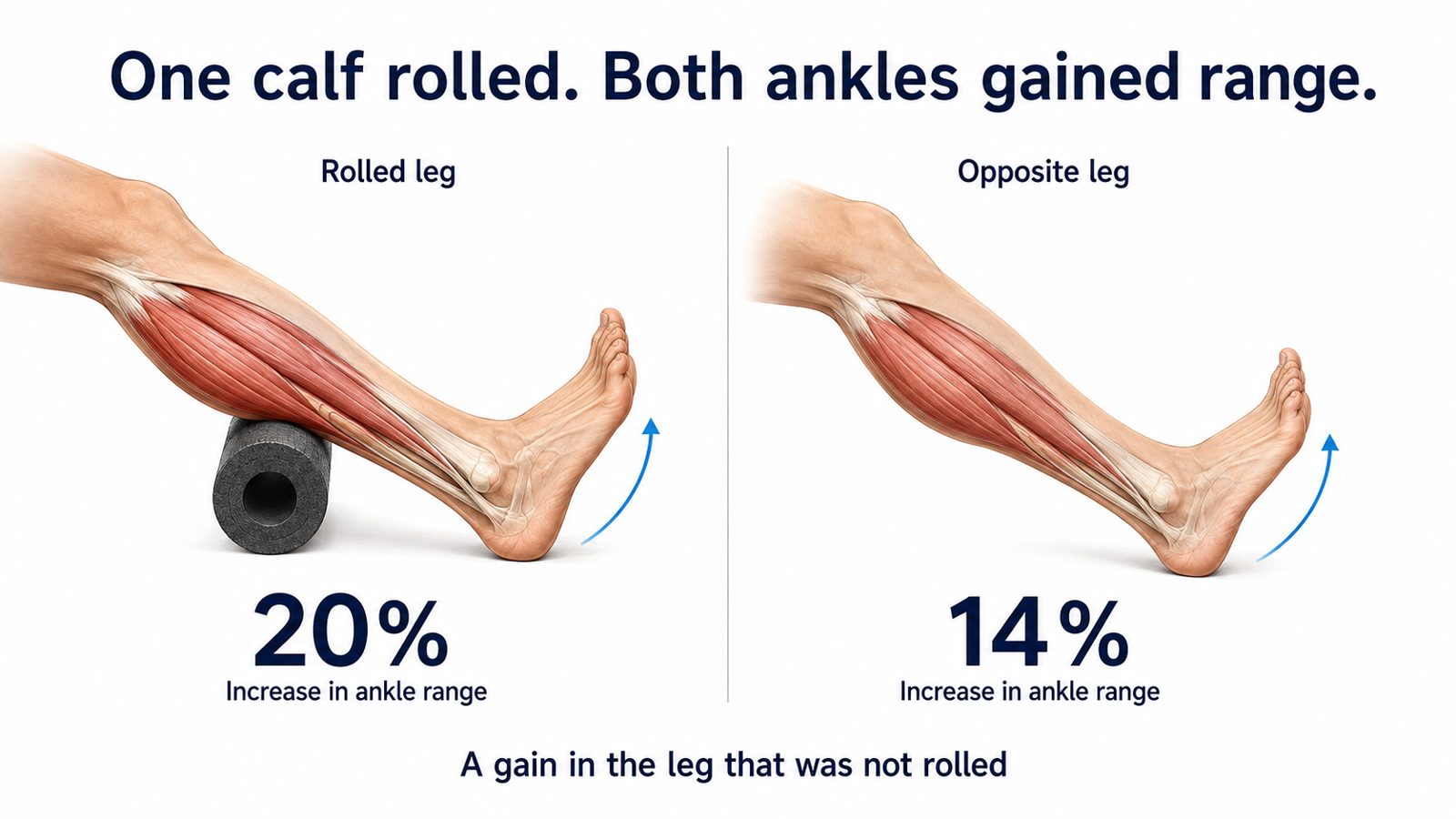
An effect that jumps to the other leg, with the tissue measurably unchanged, is not a fascial chain. The other leg is not on the chain. What it looks like to me is the brakes being eased by a strong, safe input from somewhere else in the body, through mechanisms that pain science already knows about, where one strong sensation dampens the system’s response to another. Nobody has yet done the experiment I would most like to see, which is to roll the front of the thigh and measure the back of it, and until somebody does, the fair statement is that the effect is real, the tissue does not appear to change, and the mechanism is not settled. I would also add that measuring what fascia does inside a living body is difficult, and some of the argument is about what can be measured rather than about what is true.
None of that changes the test. Your hamstrings did not get longer in a minute. Something in the nervous system changed its mind about how far you were allowed to go, and that is the point.
What it changes about how you stretch
If tightness is mostly a limit set by the nervous system, then a stretching practice is a conversation with that system, and it goes better when you speak its language.
Go in slowly. A fast entry fires the stretch reflex and the muscle contracts against you.
Find the edge and stop there. The edge is resistance, maybe a little discomfort, and never pain. Pain is the brakes, and past that point you are getting less range rather than more, and you are teaching the nervous system that this range is dangerous, which is the opposite of what you want.
Stay long enough for the system to settle. In my own teaching I use twenty to thirty seconds, repeated two or three times. The best known trial on this, ninety three people stretching their hamstrings five days a week for six weeks, found that a single thirty second hold improved range and that holding for a minute, or stretching three times a day, added nothing to it. Whether holding for five or ten minutes, as a yin practice does, adds something further over the long term has not been measured directly. Long relaxed holds sit in the low intensity group, where the studies found no change in the muscle itself, and I say so when I teach it.
Breathe out. The exhale is the half of the breath that belongs to the rest state of the nervous system, and a long, easy exhale is the simplest way in. If the breath is not smooth, the stretch is too deep.
Keep your attention on the muscle being stretched, and where it helps, contract the muscle on the other side of the joint. Contracting the front of the thigh helps the hamstrings let go, because a muscle relaxes automatically when its partner works. That is a reflex too, and it is one you can use on purpose.
Do this often, at a moderate dose, rather than rarely and hard. The brakes are reset by repetition, not by force.
And be careful about being flexible in the wrong place. Tendons and ligaments give about four percent before they tear, and the feeling of loading them, which you can find by pulling a finger back, is not a stretch and should not be practised. A hot room, a warm afternoon or an enthusiastic adjustment can all move the brakes further than the strength around a joint can support, and that is where end range injuries happen. Range you cannot control is not an asset. The clearest case in a yoga practice is the hamstring tendon at the sit bone, and I wrote about it in Is there a perfect forward fold?
What it changes about how a stretch is cued
For anybody who teaches, the same understanding changes the words.
The instruction to lengthen a muscle is not wrong in spirit, but it points the student at the wrong thing. What the student can actually influence is speed, breath, attention and the decision about where the edge is. So the useful cues are the ones that direct those. “Go in slowly.” “Find the place where you feel resistance and stay there.” “Let the exhale be longer than the inhale.” “Feel where the stretch sits in the back of the thigh.” Each of those gives the nervous system what it needs to ease off.
The cues that work against it are the ones that push. “Deeper.” “Further.” “Push through it.” A student who obeys them is pushing into pain and teaching their own body to guard, and a teacher who sees a student shaking or holding their breath is watching the brakes come on.
There is one more thing I would say. A student who cannot get far is not a student with short hamstrings. They are a student whose nervous system does not yet trust that range, and the job is to make it feel safe there, not to force it there. That is a slower, kinder and, as far as the evidence goes, more accurate way to think about tightness, and it changes the tone of a room.
What we teach, and what we do not
This is the anatomy we teach on the yoga teacher training in Bali, and it is taught by a physiotherapist rather than from a manual somebody else wrote. The foot test is in the first week of the anatomy labs. So are the spindles, the tension sensors, the stretch reflex and reciprocal inhibition, because a teacher who understands what a stretch is negotiating with cues differently for the rest of their teaching life.
What we do not teach is that stretching lengthens muscles, that fascia can be reshaped by hand, or that more range is always better. I expect some of what I teach now to be corrected in my lifetime, and I say so in the room. The foot test does not need the mechanism to be conclusive in order to be beneficial. Anyone can feel it in a minute.
Related reading: the four most common yoga injuries and how to avoid them, and what trauma informed actually means in a yoga training.
Sources used
- Freitas SR, Mendes B, Le Sant G, Andrade RJ, Nordez A, Milanovic Z. Can chronic stretching change the muscle tendon mechanical properties? A review. Scandinavian Journal of Medicine and Science in Sports, 2018. Stretching programmes of three to eight weeks do not change muscle or tendon mechanical properties; range gains are explained by increased tolerance to stretch, mostly at a sensory level.
- Panidi I, Donti O, Konrad A, and others. Muscle architecture adaptations to static stretching training: a systematic review with meta analysis. Sports Medicine Open, 2023. Nineteen studies, 467 participants. Pooled increase in resting fascicle length trivial (SMD 0.17). Significant only in the high intensity subgroup, stretching to discomfort or past the onset of pain (SMD 0.28); the low intensity subgroup showed no change. The volume cutoff was 90 minutes in total across the programme, so intensity rather than time is the deciding factor. No change in fascicle angle.
- Grieve R, Goodwin F, Alfaki M, Bourton AJ, Jeffries C, Scott H. The immediate effect of bilateral self myofascial release on the plantar surface of the feet on hamstring and lumbar spine flexibility: a pilot randomised controlled trial. Journal of Bodywork and Movement Therapies, 2015.
- Fauris P, Lopez de Celis C, Canet Vintro M, and others. Does self myofascial release cause a remote hamstring stretching effect based on myofascial chains? A randomized controlled trial. International Journal of Environmental Research and Public Health, 2021. Ninety four participants, five segments of the superficial back line; every segment improved hamstring flexibility and ankle dorsiflexion; authors offer both a fascial continuity and a neurophysiological explanation.
- Nakamura M, Konrad A, Kiyono R, and others. Local and non local effects of foam rolling on passive soft tissue properties and spinal excitability. Frontiers in Physiology, 2021. Rolling one calf improved dorsiflexion in both legs; no change in shear elastic modulus or H reflex in either leg; changes attributed to sensory factors.
- Kelly S, Beardsley C. Specific and cross over effects of foam rolling on ankle dorsiflexion range of motion. International Journal of Sports Physical Therapy, 2016. Earlier report of the contralateral effect.
- Chalmers G. Re examination of the possible role of Golgi tendon organ and muscle spindle reflexes in proprioceptive neuromuscular facilitation muscle stretching. Sports Biomechanics, 2004. Tendon organ inhibition is too brief to explain PNF gains; a change in stretch tolerance is the more likely mechanism.
- Afonso J, Ramirez Campillo R, Moscao J, and others. Strength training versus stretching for improving range of motion: a systematic review and meta analysis. Healthcare, 2021. Strength training and stretching did not differ in their effect on range of motion, though the authors note the studies were heterogeneous.
- Bandy WD, Irion JM, Briggler M. The effect of time and frequency of static stretching on flexibility of the hamstring muscles. Physical Therapy, 1997. Ninety three adults with limited hamstring flexibility, five days a week for six weeks. Thirty seconds once a day improved range; sixty seconds and three times a day were no better.
- Samasti Yoga Anatomy Manual, 2026 edition, sections on why muscles get tight, stretching, the stretch reflex and reciprocal inhibition.