
Is there a perfect forward fold?
Written by Sean Goldberg, who qualified as a physiotherapist in Australia and is a clinical Pilates instructor and the lead teacher at Samasti Yoga. Published 18 October 2026.
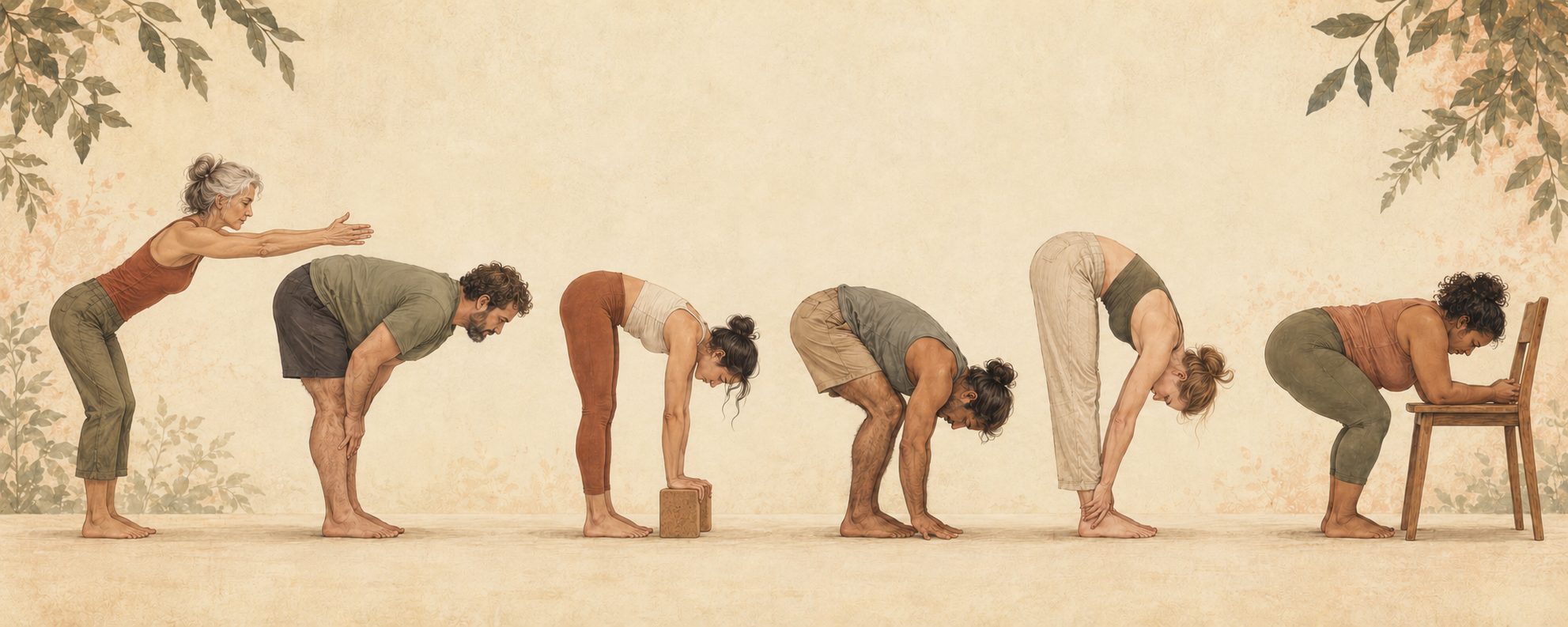
Have you ever been told, or told a student, that there is a right way to fold forward, and that once you have found it, that is the way to do it every time? Many yoga practitioners believe it because it is how it was taught. I think the search for the perfect pose is behind more yoga injuries than any single mistake, because by repeating the same movement in the same way every day, we load the same tendon at the same angle thousands of times a year. Tendons adapt far more slowly than muscles do and often struggle to cope. The clearest example is the deep ache at the sit bone (ischial tuberosity) that is often called yoga butt, which is proximal hamstring tendinopathy, and the way out of it, and out of the pattern behind it, is variety and strength rather than a better version of the same fold.
What is a repetitive strain, exactly?
Every tissue in the body has a capacity, which is the load it can take today without complaint, and it raises that capacity slowly when it is asked to. An overuse injury is what happens when we ask the tissue for more than it is able to give. There are two ways to do that. The first is too much too soon, and the second is the same thing too often, without giving the tissue a chance to recover. The second is harder to catch, because each practice on its own may feel gentle, and the student believes they are taking care of their body. Thirty forward folds in a practice, six mornings a week, is roughly nine thousand forward folds a year landing on the same two tendons at the same angle. The fact that each repetition felt fine is exactly how a repetitive strain injury is created.
Why does the tendon become painful?
A tendon is the dense rope of collagen that joins a muscle to the bone. It is far less elastic than the muscle, it has a poor blood supply, and it recovers more slowly, so the two tissues respond to the same practice at very different speeds. Muscle is soft, full of blood and quick to change, and a few weeks of regular practice makes it stronger and lets it go further, for reasons I covered in the article on why muscles get tight. The tendon beside it is asked to transmit the load of every one of those deeper folds, and it may need longer to adapt.
The size of that difference was measured in 2013, when a group in Copenhagen dated the collagen in 28 human Achilles tendons using the carbon 14 left in the air by nuclear bomb tests. The core of each tendon still carried the carbon of the person’s first 17 years and almost nothing from after, which means the tendon you have as an adult was built while you were growing and is essentially never replaced. Muscle, measured in the same study, renews itself continuously. I think this is super interesting because it explains why tendon injuries heal so slowly, and why flexibility may improve (modulated by muscle tissue) every month but the tendons may not be able to keep up. The muscle said yes to every one of those folds, and the tendon may not have been considered.
Where does it show up in a yoga body?
At the sit bone, more than anywhere else. The hamstrings attach to the ischial tuberosity through thick tendons that sit right against the bone. When you fold forward with straight legs, that attachment is stretched and pressed against the bone at the same time, the way a rope is pressed into the edge of a wall when a weight hangs over the other side.
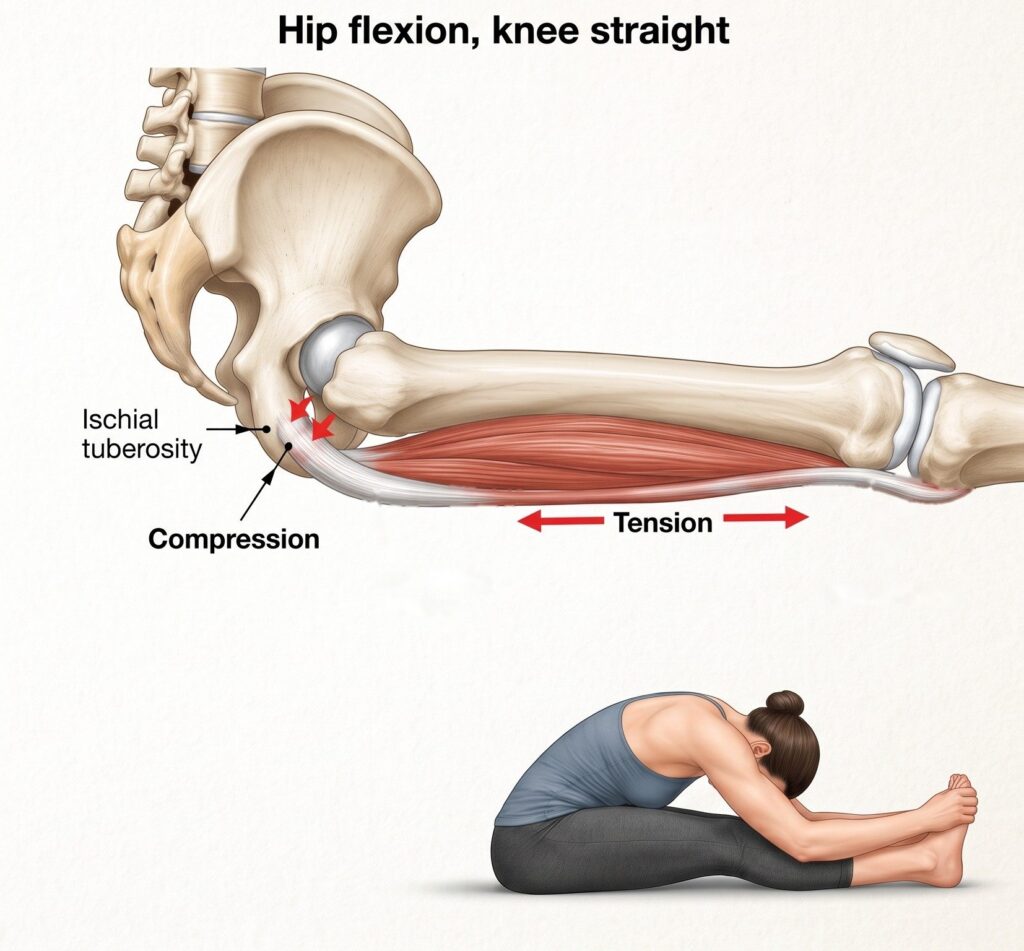
A 2016 review of this condition suggests that this compression is the most likely reason the attachment becomes painful. The forward fold is in nearly every sequence ever practised, and yogis tend to be obsessed with getting to the floor, as if that were the measure of a worthwhile practice. “Can I join your training if I can’t touch my toes?” is one of the most common questions I receive.
That one connection is loaded dozens of times in every practice. The same logic applies to the front of the hip after a thousand identical lunges, and to the wrist after a thousand identical planks.
Is it a stretch or an irritation?
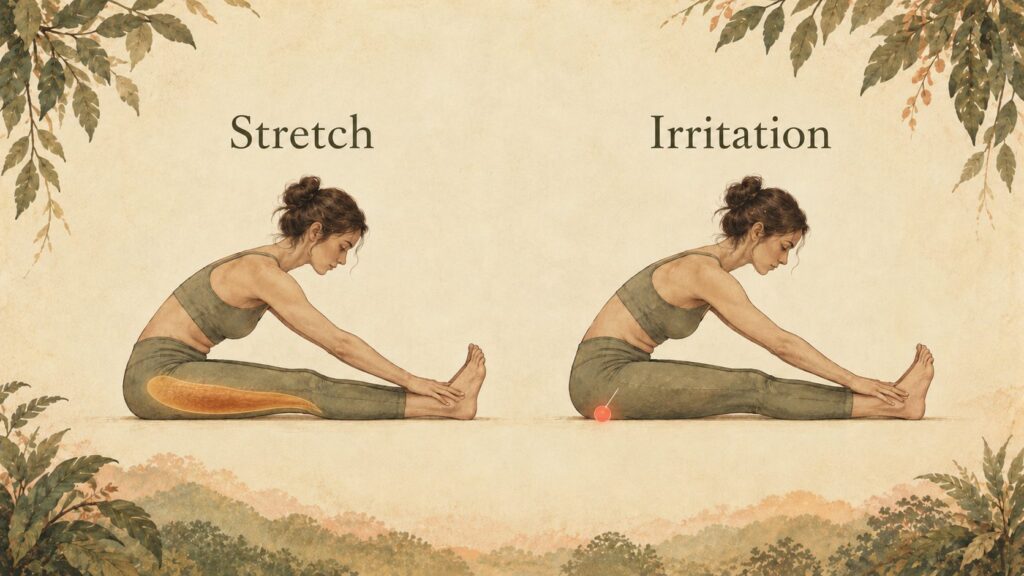
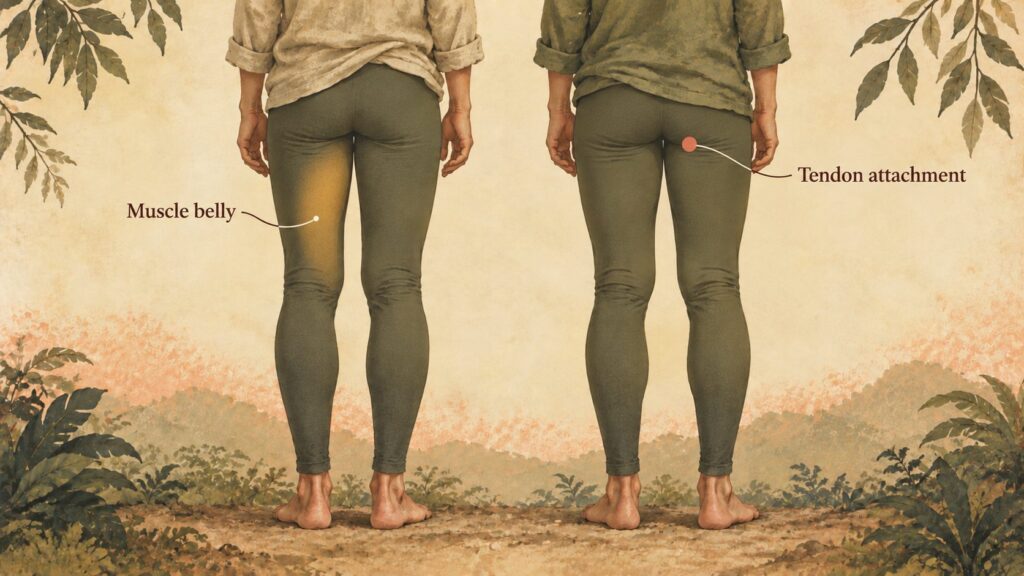
This is the subtle differentiation, and almost nobody is taught to be able to tell the sensations apart. A stretch and an irritated tendon both are perceived as pain. The student who has been told that limitation in a forward fold means tight hamstrings treats both the same way, by folding deeper and holding longer. The two messages are different if you learn to listen. A stretch is felt along the length of the muscle. It eases while you hold it, and it is gone when you come out. An irritation is local, right at the bone where the tendon attaches. It is stiff and grumbling at the start of a practice, easier once you are warm, worse the next morning, and sore after a long time in a chair. One is the nervous system’s brakes, which I wrote about in that earlier article. The other is the tissue itself asking for a different load. Stretching is the right answer to the first. For the second, stretching is the one load the tendon can least tolerate, and what it needs instead is strength.
In most cases it is not actually damage. Tendon pain used to be called tendinitis, which means inflammation, and the advice was rest and ice. The research of the last fifteen years has moved away from that. Scans of people with no pain regularly show the same changes as scans of people in pain, and a 2016 paper describes tendinopathy as primarily a pain condition. My reading of that, and it is my reading, is that a sore tendon is complaining about dose rather than reporting damage. That is better news than it sounds, because dose is something you can change. Resting it completely, which is the other thing people do, does not get you back to pain free movement.
What do you do instead?
If you have the ache at the sit bone, change the practice before you treat the tendon. For one to three weeks (this is general advice, and a physiotherapist can tailor it to you), bend the knees in every forward fold and keep the fold shallow, making sure the stretch is only felt in the muscle belly. Change the order of what you do, and give the folds a day off between practices while the rest of the practice carries on. When you sit for a long time, sit on something soft or towards the front of the chair, so the sit bone is not pressed into a hard edge. This is not rest, and it is not forever. It takes away the one load the tendon cannot tolerate at the moment, so that you can give it the one it needs.
Then load it, starting with holds. Lie on your back with your knees bent and your feet flat. Lift the hips into a bridge and hold for 30 to 45 seconds, five times, with a rest between each. The hold should feel like real work in the back of the thigh, because a tendon that is hardly loaded will not adapt. If that is easy, walk the feet further away or perform on one leg. A small trial in 2015 on the kneecap tendon found that a single set of long holds like this took tendon pain from seven out of ten to almost nothing, and kept it there for at least 45 minutes. It was six volleyball players and a different tendon, so I offer it as the reason the holds are worth trying rather than as proof.
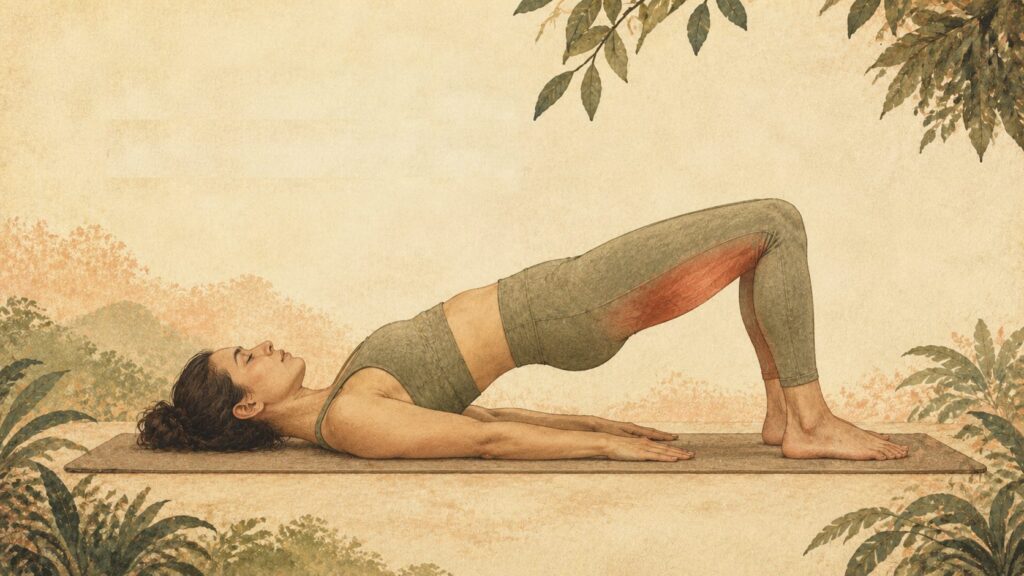
After a few weeks, add slow, heavy movement: bridges that lift and lower, hip hinges with a long back and soft knees, and a kettlebell or a backpack of books once bodyweight is easy. Heavy means that eight slow repetitions are hard to finish. Build it over months, because the tendon takes time to adapt. If the pain is worse the next morning, the dose was too high and you take a step back. That rule and the whole sequence are borrowed from the Achilles and kneecap tendons. The only systematic review of this condition, published in 2021, found twelve studies and not enough evidence to recommend any one treatment.
What does the perfect forward fold cost?
A set sequence, and Ashtanga is the best known of them, has a real virtue. Once the body knows what to expect as the next movement in the sequence, the mind has nothing that it needs to work out and can deepen its awareness in the practice. It is also where I see this injury most. The sequence is the same every morning, and the belief that I often encounter is that there is one correct way to perform a forward fold, which you refine and then repeat for the rest of your life. A fold repeated that faithfully, or I would say dogmatically rather than yogically, loads one corner of the body in one way for years. The student who follows it most devotedly is the one who has the potential to encounter this type of injury.

The deeper problem is the idea of a perfected pose. Every fixed form of a posture was worked out by one person for the bodies in front of them at the time, and those bodies were not yours. Hip sockets sit at different depths and angles, hamstrings attach at different points, and no two sit bones meet a forward fold in the same way. An asana is the expression of a posture as your body feels it in that moment. The practice is to listen to what the body is saying today and let the fold be whatever that produces, rather than to press the body into a form that somebody else’s body made.
The answer is variety as a principle rather than a different dogma. That means a practice that changes its order, its depth and its emphasis through the week. It includes work where the muscles are strong at the end of their range, rather than only long. It treats a sore tendon as information about the dose. For the teacher, the cue is the opposite of the one that created the problem: bend the knees, fold less, and press the heels into the floor at the bottom of the fold so the hamstring is working while it is long. Focus on the sensation you want the student to notice. You can ask them where the sensation is, rather than telling them it is tightness. On the yoga teacher training in Bali the anatomy labs spend time on tendons for this reason. A teacher who can tell a muscle asking for length from a tendon asking for strength will build a very different year of classes.
The perfect forward fold is the one your body asked of you today.
Sources used
- Goom TS, Malliaras P, Reiman MP, Purdam CR. Proximal hamstring tendinopathy: clinical aspects of assessment and management. Journal of Orthopaedic and Sports Physical Therapy, 2016.
- Nasser AM, Vicenzino B, Grimaldi A, Anderson J, Semciw AI. Proximal hamstring tendinopathy: a systematic review of interventions. International Journal of Sports Physical Therapy, 2021.
- Heinemeier KM, Schjerling P, Heinemeier J, Magnusson SP, Kjaer M. Lack of tissue renewal in human adult Achilles tendon is revealed by nuclear bomb 14C. FASEB Journal, 2013.
- Cook JL, Rio E, Purdam CR, Docking SI. Revisiting the continuum model of tendon pathology. British Journal of Sports Medicine, 2016.
- Malliaras P, Cook J, Purdam C, Rio E. Patellar tendinopathy: clinical diagnosis, load management, and advice for challenging case presentations. Journal of Orthopaedic and Sports Physical Therapy, 2015.
- Rio E, Kidgell D, Purdam C, Gaida J, Moseley GL, Pearce AJ, Cook J. Isometric exercise induces analgesia and reduces inhibition in patellar tendinopathy. British Journal of Sports Medicine, 2015.