
Why do you sigh? What your body already knows about calming your nervous system
Written by Sean Goldberg, who qualified as a physiotherapist in Australia and is a clinical Pilates instructor and the lead teacher at Samasti Yoga. Published 20 September 2026.
You sigh around a dozen times an hour, mostly without noticing. So why do you do it? Take a guess before you read on.
Whatever you guessed, the answer turns out to be useful, because a sigh is your body letting go, and you can borrow it on purpose. Breathe in through your nose, take a second short sip of air on top, then let it all out in one long, slow exhale through your mouth. Repeat that for about a minute. In a small trial published in 2026, one minute of this lowered students’ anxiety in real stressful moments. The researchers call it cyclic sighing, and you may have heard it called the physiological sigh.
The first answer is in your lungs
Every few minutes you take a breath that is about twice the size of your average. Your lungs are made of millions of tiny air sacs called alveoli. With quiet breathing (your resting breath) some of them slowly collapse, and a collapsed sac stops exchanging oxygen and carbon dioxide. A sigh opens them again.
It works by size. An ordinary breath does not stretch the lung far enough to pull a collapsed sac back open, and a breath twice as big does, the way a balloon that has stuck to itself needs one bigger puff before it will open. The bigger stretch also prompts the lung to release more of the slippery film that keeps the sacs from sticking shut.
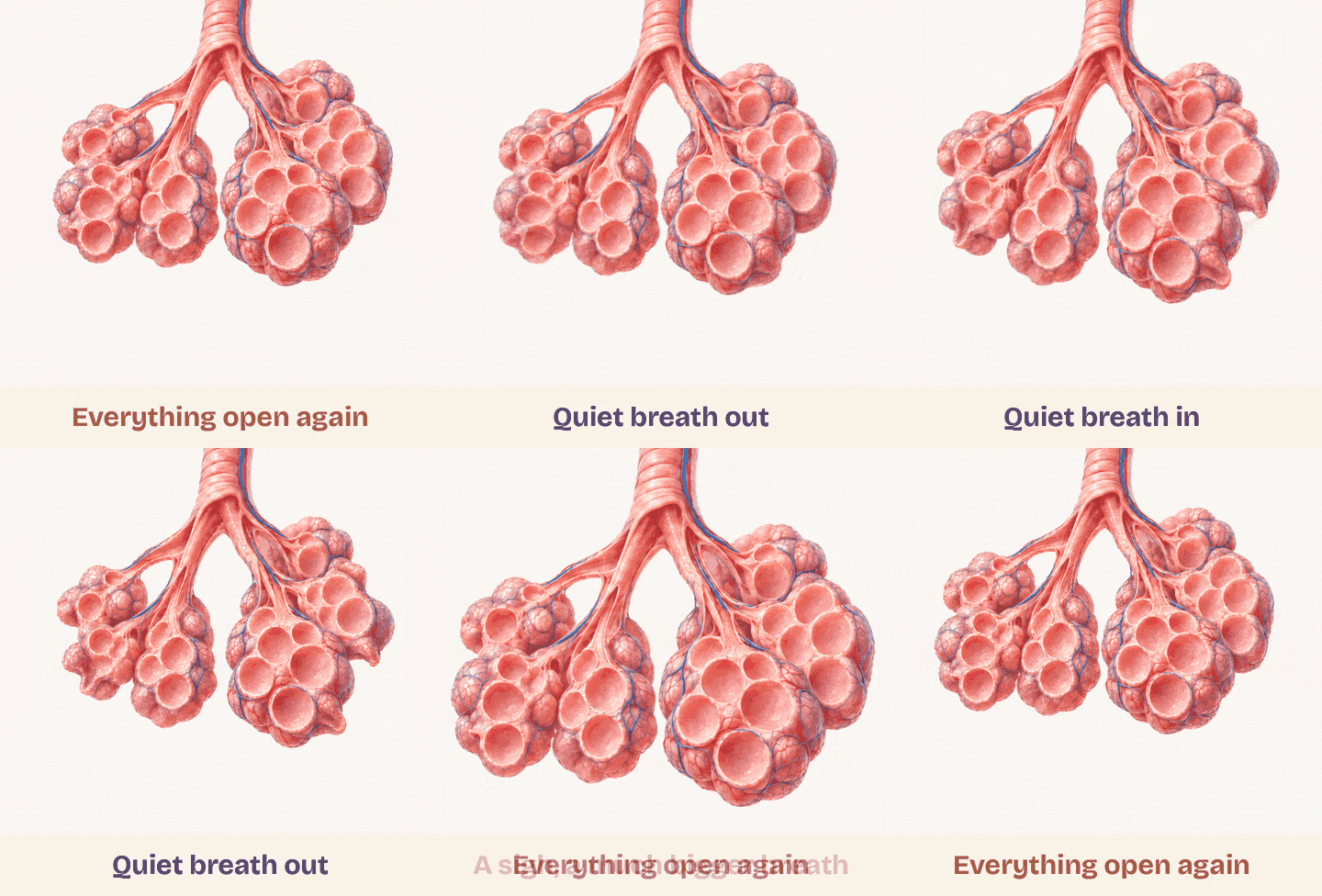
The researchers who found the brainstem circuit for sighing in mice put it plainly: without sighing, the lungs would slowly fail.
The second answer is more surprising
If you guessed sadness, tiredness or frustration, that is not wrong. Sighs do come with all of those. But in a series of experiments, people sighed more when a stressful noise ended than while it was playing.
In a later study from the same group, people felt more relief straight after a deep breath, and in people prone to anxiety a spontaneous sigh was followed by lower muscle tension. The researchers who study sighs describe them as a reset. A sigh tends to arrive at the moment one state ends and the next begins, the body’s way of closing a chapter before it moves on.
What is the sigh doing to your heart?
You can do a little self experiment to feel part of the answer yourself. Put two fingers on the pulse at your wrist and breathe slowly in for about four seconds and out for about six, a few times over.
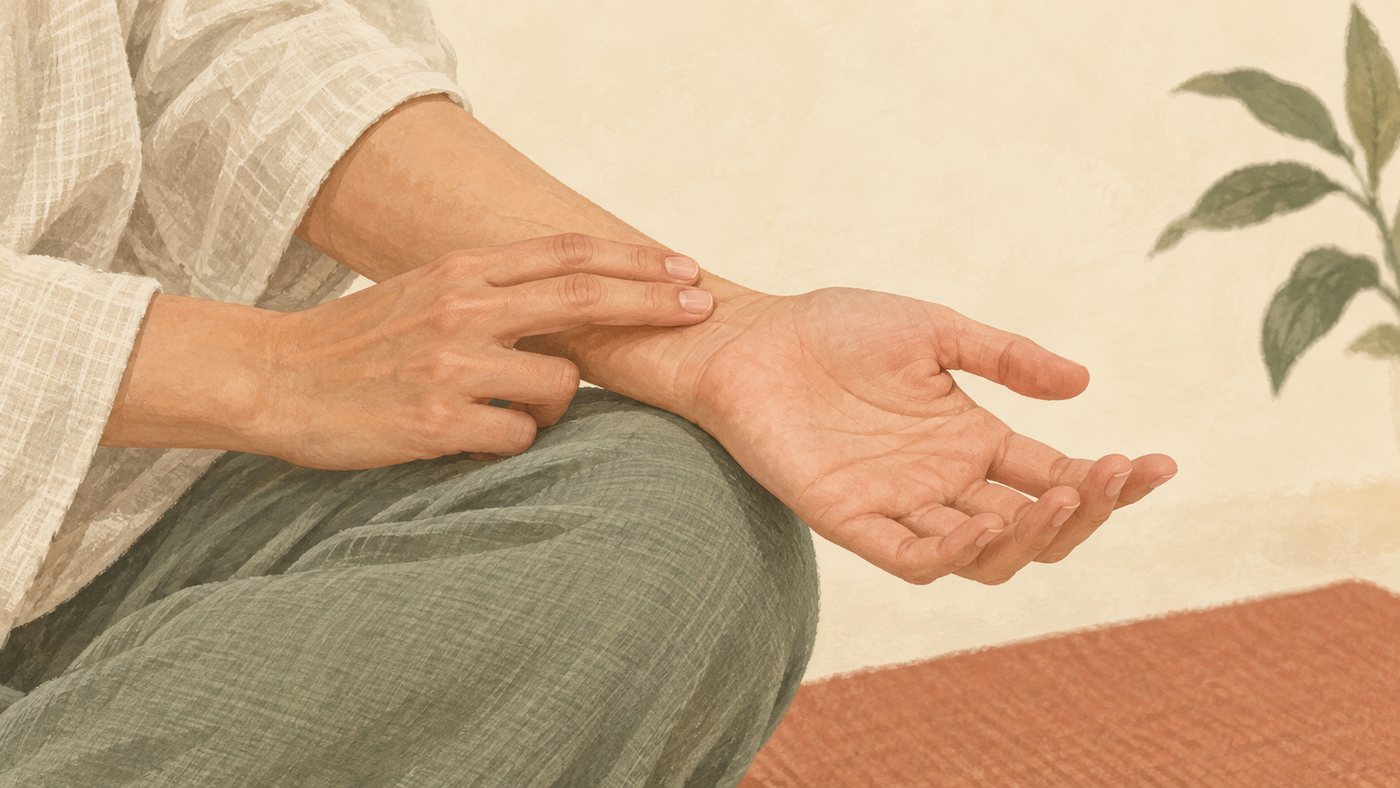
Many people can feel the pulse speed up slightly on the in breath and slow down on the out breath. It has a name, respiratory sinus arrhythmia, and it is normal and healthy. Your heart has been doing it all your life, thousands of times a day.
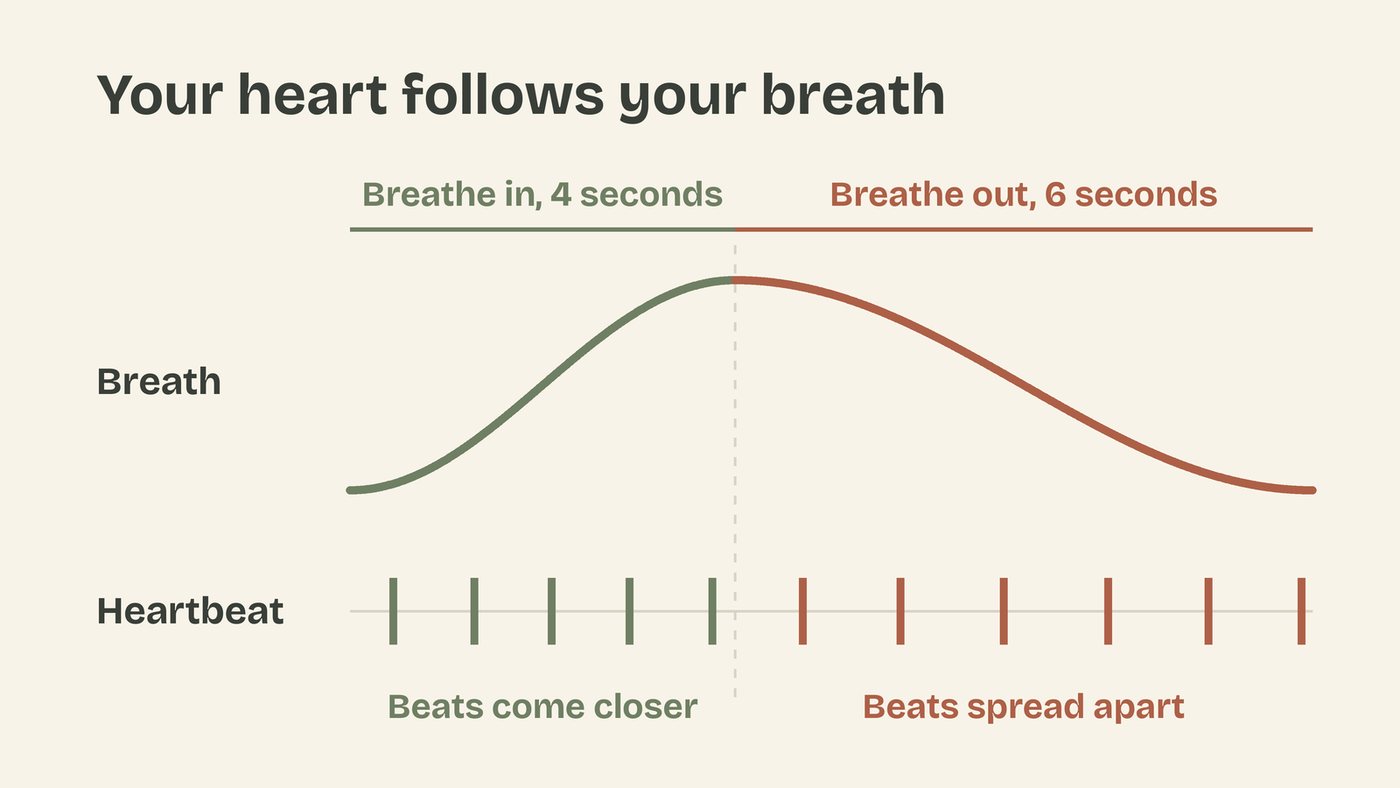
Your nervous system has two branches. The sympathetic branch gets you ready to act, and the parasympathetic branch settles you back down, mainly through the vagus nerve. Think of your breathing as driving. Each inhale presses lightly on the accelerator and each exhale presses lightly on the brake.
This is why the sigh calms you. A sigh is a slow breath with a long exhale, and a minute of sighs brings your whole breathing down to a few breaths a minute. When you breathe slowly, the rise and fall in your pulse gets bigger. Because the exhale is the longer part of each breath, your foot is on the brake for more of every minute, and the calming branch of your nervous system has more of an impact on your overall pulse. A 2022 review of more than two hundred studies found exactly this: the heart’s parasympathetic activity rises during slow breathing, straight after a session, and at rest after weeks of practice.
How to sigh on purpose
- Sit or stand comfortably.
- Breathe in through your nose until your lungs feel full.
- Without breathing out, take a second short breath in through your nose to top them up.
- Breathe out slowly through a soft, open mouth until your lungs feel empty, and let the air fall out rather than pushing it. A light haa sound could be added.
- Repeat for about a minute.
Keep it slow rather than forceful. Big, fast breaths get rid of carbon dioxide faster than the body makes it, the blood vessels in the brain narrow, and people end up dizzy rather than calm. If you feel light headed, slow down and go back to ordinary breathing. If your nose is blocked, breathing in through the mouth is fine.
One thing I see often is people who feel overwhelmed pushing the air out slowly through pursed lips. It lengthens the exhale too, but it is a way of holding on and controlling the breath, which is the opposite of what a sigh is for. My own view is that it is a way of controlling the emotion too, containing it rather than allowing it. You can feel the difference for yourself.
Put a hand on your belly and breathe out slowly through pursed lips, and you will feel the muscles of your abdomen tighten to squeeze the air out. Now sigh instead, and the belly simply softens as the air falls out on its own, often with a sound, an open “haaa” as the chest drops. Let it come. The same researchers found that breathing to a controlled pattern felt demanding and created tension, which fits what I see, though nobody has yet compared pursed lips with a sigh directly.
What it can and cannot do
In the 2026 trial, a minute of sighing brought anxiety down in the moment, and that is worth having. Most of the research measured the minutes straight after breathing. Practised over weeks, slow breathing raises the heart’s parasympathetic activity outside the practice too.
None of the research shows breathing resolving whatever is behind the anxiety. This is a way to settle yourself in the moment rather than a treatment for anxiety. If anxiety is a regular part of your life, the breath can steady you, and the work underneath it, feeling what is held in the body rather than breathing it away, is what a somatic therapist is for. It is also the ground we work on in our yoga teacher training in Bali, where the work is with the causes of anxiety rather than with relief from its symptoms.
Is this pranayama?
The Hatha Yoga Pradipika, written around the fifteenth century, tells the practitioner to exhale “slowly, not fast”. Slowly is the word the modern research backs most firmly.
Humming and chanting Om work the same way. You will often hear that the vibration of the hum stimulates the vagus nerve. A 2026 study put that to the test and found that the calming effect on the heart came from the slow breathing that humming forces on you, about six breaths a minute with a long exhale, rather than from the vibration itself. A 2001 study in the BMJ found the same slowing when people recited a mantra. The slow exhale is the cause, not the vibration itself.
It is the same slowing down that helps a stretch, which I wrote about in why muscles get tight. On the training, breath is taught this way, with the pranayama and the physiology side by side, so that a teacher can say what a practice does and where the evidence stops.
Sources used
- Riedl EM, Bracklo T, Wimmer K, and others. Simply breathing anxiety away? One minute cyclic sighing versus box breathing for acute anxiety reduction in real life. Anxiety, Stress and Coping, 2026. Preregistered pilot, 47 university students; both methods reduced state anxiety compared with a passive control.
- Yasuma F, Hayano J. Respiratory sinus arrhythmia: why does the heartbeat synchronize with respiratory rhythm? Chest, 2004.
- Laborde S, Allen MS, Borges U, and others. Effects of voluntary slow breathing on heart rate and heart rate variability: a systematic review and a meta analysis. Neuroscience and Biobehavioral Reviews, 2022. 223 studies; vagally mediated heart rate variability rose during slow breathing, immediately after one session and after multi session programmes.
- Stocchetti N, Maas AI, Chieregato A, van der Plas AA. Hyperventilation in head injury: a review. Chest, 2005. Lowering carbon dioxide by hyperventilation causes cerebral vasoconstriction and reduces cerebral blood flow.
- Boulding R, Stacey R, Niven R, Fowler SJ. Dysfunctional breathing: a review of the literature and proposal for classification. European Respiratory Review, 2016. Hyperventilation syndrome and its symptoms related to respiratory alkalosis.
- Severs LJ, Vlemincx E, Ramirez JM. The psychophysiology of the sigh: I: The sigh from the physiological perspective. Biological Psychology, 2022. Sighs occur every few minutes and prevent the collapse of alveoli.
- Vlemincx E, Severs L, Ramirez JM. The psychophysiology of the sigh: II: The sigh from the psychological perspective. Biological Psychology, 2022. Sighs as resetters of respiration and of psychophysiological state.
- Vlemincx E, Van Diest I, De Peuter S, and others. Why do you sigh? Sigh rate during induced stress and relief. Psychophysiology, 2009. Across three experiments, more sighing during relief than during stress.
- Vlemincx E, Van Diest I, Van den Bergh O. A sigh of relief or a sigh to relieve: the psychological and physiological relief effect of deep breaths. Physiology and Behavior, 2016. Self reported relief rose after an instructed deep breath; frontalis muscle tension fell after a spontaneous sigh in high anxiety sensitive people.
- Li P, Janczewski WA, Yackle K, and others. The peptidergic control circuit for sighing. Nature, 2016. The abstract describes sighs as expressing sadness, relief or exhaustion and as occurring every few minutes to reinflate alveoli. Read with the UCLA release for one sigh about every five minutes at twice the volume of a normal breath. The circuit was identified in mice.
- Vlemincx E, Van Diest I, Van den Bergh O. Imposing respiratory variability patterns. Applied Psychophysiology and Biofeedback, 2012. Breathing to an imposed pattern was difficult and demanding and induced tension.
- Kim T, Lee S, Woo M. Humming breathing and autonomic regulation. Applied Psychophysiology and Biofeedback, 2026. The effects of humming were associated with slow breathing near 0.1 Hz from extended exhalation, not with the vibration itself.
- Bernardi L, Sleight P, Bandinelli G, and others. Effect of rosary prayer and yoga mantras on autonomic cardiovascular rhythms: comparative study. BMJ, 2001. Twenty three adults; recitation slowed breathing to about six breaths a minute and increased baroreflex sensitivity.
- Hatha Yoga Pradipika, chapter 2, verse 9.