

What Level 2 is
Level 2 is not only more asana, it is the layers underneath the asana.
A 200 hour provides the tools to be a teacher. It gives you experiences, postures, sequencing, a voice and enough anatomy to keep a yourself and a classroom safe. The 300 hour is a different task. It moves from learning to teach, to teaching from the subtle, energetic and therapeutic layers of the practice, and it asks you to have lived those layers yourself first.
So the material goes deeper on both sides at once. Tantra, mantra, the chakra system, pranayama with real breath holds and ratios, meditation drawn from four traditions, and three days of silence. The anatomy is taught by a clinical physiotherapist and pilates instructor. We explore working with injury, bodywork, fascia and somatic techniques.
Who this is for
What the training assumes you can already do
The formal requirement is a completed a 200 hour certified course with a Yoga Alliance registered school. The more useful question is are you ready for a level 2 with Samasti?
Coming in, you can
Five things to know if you are ready
Hold a personal practice on your own, most days, without a teacher in the room.
Read a body in front of you. What a joint is doing, where load is travelling, when to change something and why.
Stay steady when a student’s nervous system is activated in your class, and know what to offer next.
Treat breath and stillness as practices in their own right, not as the warm up and the cool down.
Speak about the philosophy from your own experience of it, not only from your notes.
If that list gave you pause
Tell us what your 200 hour covered
Every 200 hour makes its own choices about what to fit into a month, and no training covers everything. Somatic work, nervous system regulation and working anatomy are simply not part of every syllabus, and there is nothing wrong with a teacher who was taught something else.
So we would rather look at content than at certificates. Put your 200 hour in the interest form: where, when, and what it actually covered. Sean reads them himself and will tell you plainly whether to come straight into the 300 hour.
Where there is a gap, we close it with a bridging course you work through online before you fly out, including a call with Sean. It is included in your fee, not an extra, and it means you arrive on the same footing as everyone else.
These foundations are where our own 200 hour training spends its four weeks.
What you study
Eight areas, taken from introduction to mastery
The eight areas your 200 hour introduced, taken into advanced territory. Open any one to read how far each goes.
AsanaA deeper practice rather than a harder one. The subtle body inside shapes you already know.+
Advanced practice taught as a deeper practice rather than a harder one. Where the subtle body sits inside a shape you already know, how the energetic layers change what a posture is doing, and what happens to your own practice when you stop chasing the shape.
PranayamaBreath holds and ratios, taught with the physiology, so you know what you are asking of a nervous system.+
Advanced pranayama with real breath holds and ratios, taught alongside the physiology so you know exactly what you are asking of a nervous system, your own and a student’s.
MeditationFour traditions studied as distinct methods, building to three days of silence in week three.+
Practices drawn from Buddhism, Tantra, Advaita Vedanta and Kashmir Shaivism, studied as distinct methods rather than blended into one. Week three holds a three day silent retreat, and everything before it is preparation for that.
Bandha and MudraLocks and gestures as working tools, and kundalini practice from the tantric tradition, taught in sequence.+
Bandha and mudra as working tools rather than as terminology, and kundalini practices from the tantric tradition, taught carefully and in sequence.
Anatomy, Level 2Taught by a physiotherapist. Injury, fascia, bodywork and somatic technique.+
Taught by Sean, a registered physiotherapist. Injury prevention and what to do when someone arrives with one. Bodywork and fascial release you can use on a student. Somatic technique, so you can work with what the tissue is holding rather than only with the shape. This is the module outside teachers most often say their 200 hour left thin.
Asana LabsAlignment, adjustment and advanced sequencing, practised on each other until the hands on skill is real.+
Masterclass work on alignment, adjustment and sequencing for the subtle body, practised on each other rather than described, so the hands on skill is real by the end of the month.
MethodologiesTheming a class toward a therapeutic outcome, and two full one hour slots teaching your peers.+
Class theming built from the ancient texts and aimed at a therapeutic outcome, so a class has an argument rather than a playlist. You teach two full one hour slots and get worked with on both.
PhilosophySutras, Gita, Ayurveda, the chakra system and Sanskrit, taught from a living lineage.+
Yoga Sutras and the Bhagavad Gita, yoga history, Ayurveda, purification practice, cosmology, yoga nidra and Sanskrit. Subtle anatomy sits here too: the chakra system, mantra and yantra, taught from a living lineage rather than from a chart on a wall, with the theory that explains how to bring them into a class without losing the room.
A day at Samasti
From sunrise practice to evening lecture
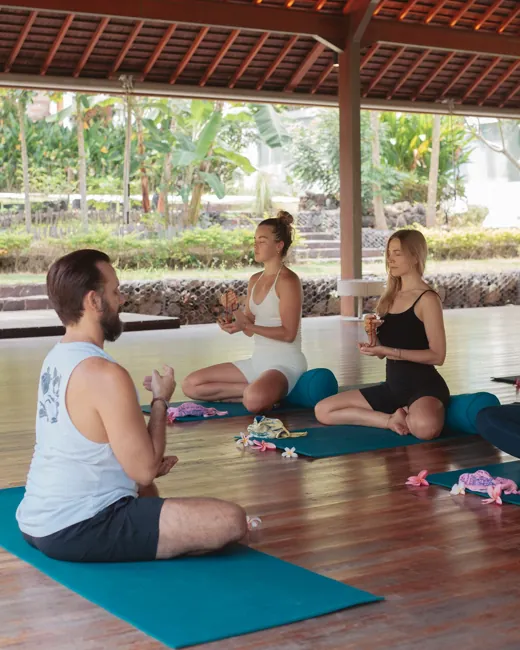
The rhythm is the one our graduates remember from their 200 hour. The content inside it is not.
Week three
Three days of silence
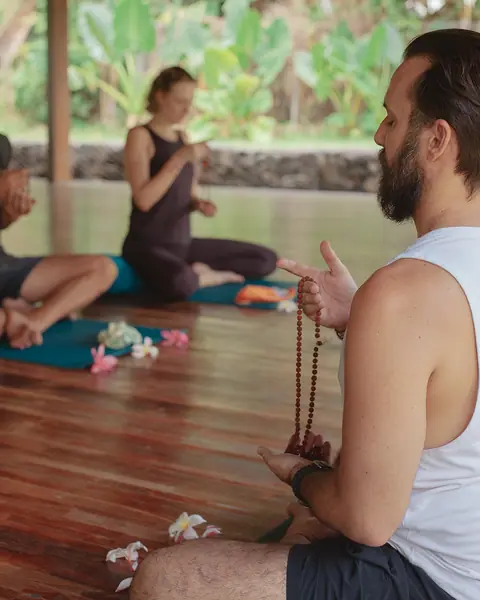
In the middle of the training, everything stops. No talking, no phones, no teaching. Three days of sitting, walking, breathing and eating in silence, held by the teachers, in the shala and the gardens you already know.
Most people find it the hardest part of the month and the part they talk about afterwards. It is also the most practical thing on the schedule. You cannot teach meditation from a handout, and after three days you are teaching from lived experience.
Where you will live
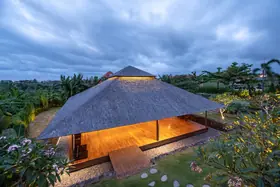
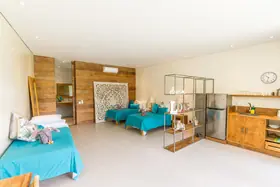
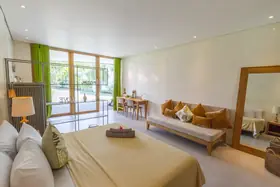
A purpose built shala in the rice fields
Accommodation on site, two organic vegetarian meals a day with vegan, gluten free and celiac options, daily cleaning and 24 hour security. The beach is a short drive.
Who teaches it
Your Teachers
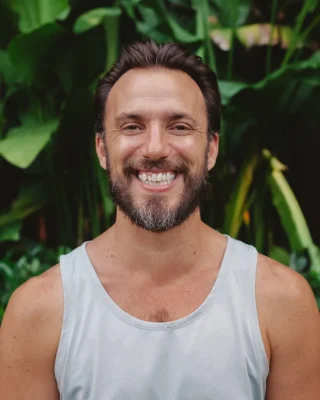
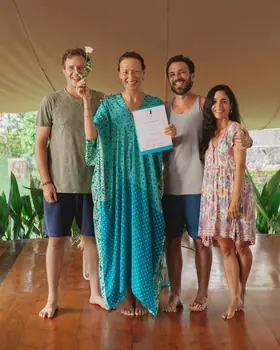
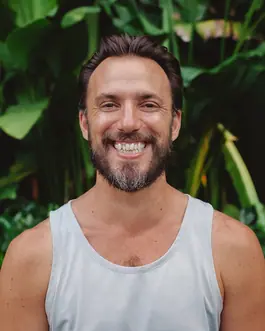
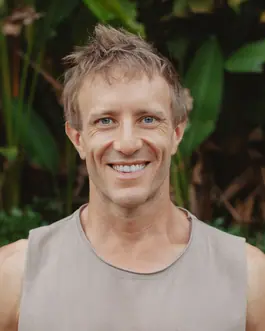
Sean leads the anatomy and the meditation. The senior teachers carry the rest.

Words from graduates
What people say once they have taught
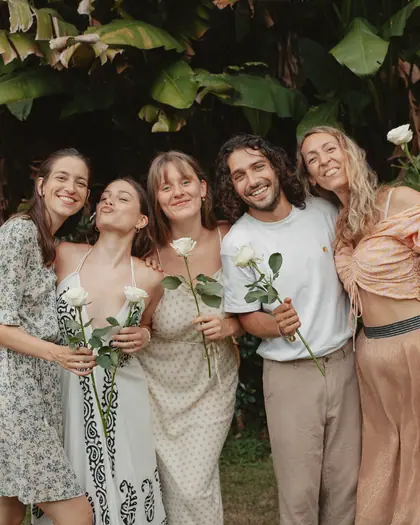
“We got to teach 2 full practice classes where other YTT will give you 15 minutes and send you off in the world.”
“What Sean, Bernd and the team have cultivated is truly unique and one of a kind in the world, deeply embedded within scientific knowledge and evidence based practice.”
“Sean is an exceptional teacher. As a physiotherapist, he brings incredible depth and clarity to his teaching.”
“One of the most beautiful and profound experiences of my life. The level of professionalism, commitment, dedication and knowledge from the team is second to none.”
Investment
One training, three ways to stay.
Every option includes the complete 4 week training, the 50 hours of online study and all inclusions. The only difference is your room and meals. Book early and save IDR 5,000,000.
Everything except accommodation and meals
Early bird, book 3+ months ahead, save IDR 5,000,000
Early bird, book 3+ months ahead, save IDR 5,000,000
Trainings that look cheaper on the page usually leave out meals and accommodation. Ours are in the price, so what you see is close to what the month will actually cost you.
Places go to the interest list first. Register and you hear the dates before anyone else.
Register your interest
Tell us what you need from it, and when
Level 2 groups are small, and dates and places go to this list first. Tell us what you want to go deeper in and the window that would suit you, and we will come back to you personally.
No obligation and no payment. Nothing is being held or sold here.
Sean reads every one and replies personally, including on whether the timing is right for you.
You hear the dates first, before they go on the site.
You are matched to the cohort that suits your timing, not simply added to a mailing list.
Questions
Frequently asked
My 200 hour did not cover somatic or subtle work. Can I still join?+
Often, yes, and it is a common starting point. The 300 hour moves quickly through material that assumes some somatic and nervous system grounding, so the answer depends on your practice rather than on your certificate. Tell us what your 200 hour covered in the interest form and Sean will give you a straight answer. Where there is a gap, we close it with a bridging course you do online before you arrive. It is included in the fee, so you are not paying extra and you are not catching up once the training starts.
How is the training structured+
Four weeks with us in Bali, and 50 hours of online study around it, which you can work through before you arrive and in your own time afterwards. If you need the bridging course as well, that is a further 50 hours online, done before you fly out. The bridging is included in the fee.
What is the prerequisite?+
A completed 200 hour training with a Yoga Alliance registered school, wherever you did it. Beyond that, the training assumes the capabilities listed higher up this page.
What certification do I get?+
A Yoga Alliance accredited 300 hour, Level 2. Held together with a 200 hour it makes you an RYT 500.
What is included?+
Every tier includes the training, Yoga Alliance accreditation, all materials, access to the lead teachers, excursions, a welcome pack and a traditional Balinese ceremony. The shared and private room tiers add your room, daily cleaning and two organic vegetarian meals a day.
What style of yoga is taught?+
Traditional Hatha as the ground, with tantra, Vinyasa and therapeutic work through the month, and a strong emphasis on pranayama and meditation at this level.
Do I need to want to teach?+
You need to have trained as a teacher, but plenty of people take Level 2 mainly for their own practice. The teaching work is part of the training either way.
When will the next 300 hour run?+
Dates for the next 300 hour go to the interest list before they are published, so registering is the way to hear them first. Tell us the window that would suit you and we will come back to you.
Is Bali safe?+
Yes. Bali welcomes millions of visitors a year and our venue sits in a quiet area outside the busiest parts of Canggu, with 24 hour security.
How do I get there?+
Fly into Denpasar, then roughly an hour by road to Canggu. We send full instructions once you are enrolled and can arrange an airport pickup.