
What is somatic yoga, and is it just yoga done slowly?

Written by Sean Goldberg, who qualified as a physiotherapist in Australia in 2004 and has taught yoga teacher trainings since 2011. Published 1 November 2026.
Somatic yoga is yoga practised for what you can feel from the inside rather than for what the posture looks like from the outside. The word comes from Thomas Hanna, who in the 1970s used soma for the body as it is perceived from within, by the person living in it. In a somatic class the movements are usually slower and smaller, because the teacher asks you what you notice more often than she tells you where your knee should be. The aim of a posture is to increase awareness rather than just simply becoming more flexible. Somatic yoga has no poses of its own, because it is a way of paying attention that you can bring to any yoga practice. The speed is not the issue, but rather where is the attention in the practice.
Can you feel the difference in two minutes?
Sit on a chair and stretch the right side of your neck, letting your ear move towards your shoulder. Hold it there for twenty seconds before you come back. In the way this was cued, notice what the goal of the pose was and what you were probably paying attention to. For most people the focus and the goal is how far the ear got.
Now do the left side with your eyes closed, slowly and only a third of the way, and ask where the centre of the sensation is, whether it has edges, whether it is sharp or blurred, and whether it changes when you breathe. Go further only if the sensation invites you, stop before the edge, and compare the two sides.
The same movement became a different practice when you changed what you paid attention to.

What is the point of feeling more?
Sensation is the only way the body has of telling you what state it is in, and most of us have lost the ability to read it. A clenched jaw, a braced belly and a breath that never reaches the ribs all run underneath awareness, and they run you, because they set your mood, your energy and how you react to people, and you cannot change any of that while you cannot feel it. The moment a holding becomes something you can feel, it becomes something you can choose what to do about, and often it lets go simply because it was noticed to be unnecessary.
Feelings work the same way, since they are body states before they are thoughts, so a person who can feel the first stirring of anxiety in her chest meets it at a size she can handle instead of being ambushed by it an hour later as a thought she cannot argue with. Where that road ends is in the class section below, and the neck side bend is the first step onto it.
Is somatic yoga just slow yoga?
Slowness is what you see from the doorway, but from the inside the question has moved from how far can I go to what is here. When a student who is already feeling a stretch asks why she should go further, my answer is that she does not need to, because if flexibility were the road to inner peace we would all be sitting in classes asking gymnasts how they found it. A fast practice can be somatic when the attention stays in the body, and a slow one can be spent entirely planning tonight’s dinner in your head.
Where does the word come from, and did yoga need it?
Moshe Feldenkrais published Awareness Through Movement in 1972. Eleanor Criswell’s How Yoga Works: An Introduction to Somatic Yoga followed in 1987, so the phrase is nearly forty years old. A 2022 history of the field argues that Hanna played down his debt to yoga and other traditions outside the West, so yoga was somatic long before the word existed. What is new is the social media wave spreading a term that no school or professional body actually defines.
What happens in a somatic class?
Curiosity is the guide, and the first surprise for most people is how little of their own body they can feel. So a somatic class starts with the practical layer, which is knowing where your shoulders are, where your hips sit, what a neutral spine feels like from the inside rather than from a mirror. Many are not aware of where their body even is in space, so this is the essential starting point.
Once that feedback is there, the attention can go to a subtler layer, which is the sensation itself (interoception): where it sits, whether it has edges, whether it is sharp or blurred, or whether it changes when you breathe. Over time, and this happens over months rather than in a class, the same curiosity reaches the layers of feeling and thought that sit under the sensation, and the student notices that none of what she senses is her, because she is the one who perceives the sensations. That, to me, is the teaching that somatic work is for: the more of the body you can be aware of, the clearer it becomes who you are not, and that is how you experience the truth of who you are.
How is that different from a stretch?
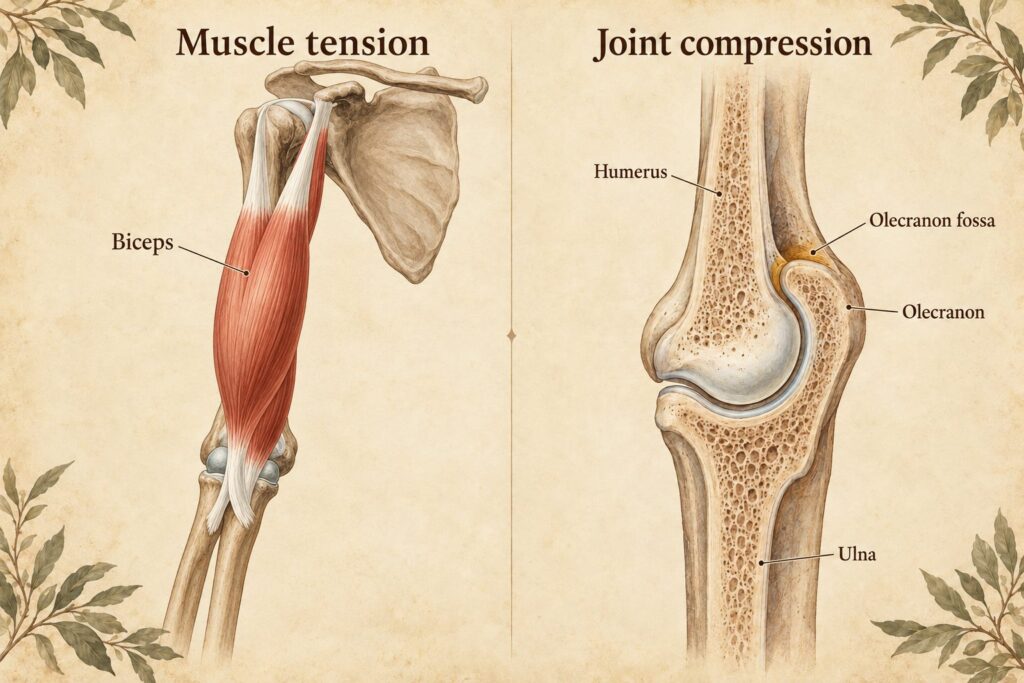
Straighten one elbow as far as it goes, and notice that you know where it stops without thinking about it. Now straighten it again and look for the sensation when the movement comes to an end, and you will find either compression at the back of the elbow, which is the joint, or a stretch through the biceps at the front, which is muscle.
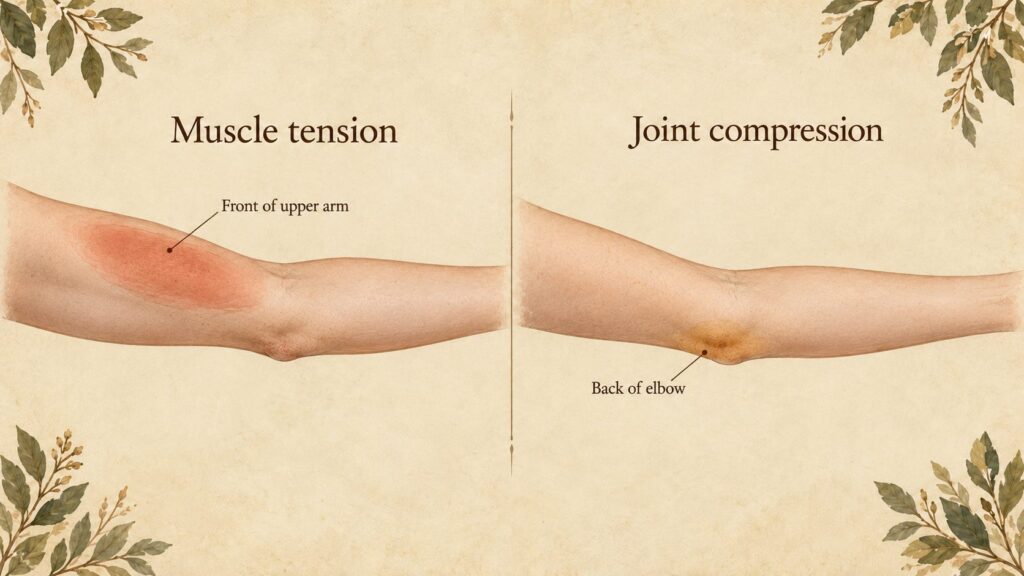
Being instructed to stretch asks how far you can go, and a somatic version asks where is the sensation stopping you, which is the cue I gave teachers in the article on the perfect forward fold. On our yoga teacher training in Bali I teach these as the two kinds of stop: muscle tension, which changes for the reasons I gave in why muscles get tight, and bone meeting bone, which does not change, only wears, and is the one never to push.
Does somatic yoga do anything?
The honest answer is that the research is thinner than the marketing. Yoga helps chronic back pain about as much as a stretching class or physiotherapy, no trial has compared somatic yoga with ordinary yoga, and when attention to the body is trained on its own the gains in accuracy are small and slow. The one result I find telling is that training people to sense their heartbeat lowered their anxiety even though their accuracy barely improved, which suggests the practice does not teach you to feel more but to feel without alarm. That is the opposite of what the marketing promises, and it is exactly what I see in the shala.
The strongest evidence that attention can change pain comes from Pain Reprocessing Therapy, which pairs psychological work with sensation tracking. In a 2022 trial of 151 people, two thirds of those who had it were pain free or nearly so after four weeks, against one in five given a placebo. The Alexander Technique has one large trial for back pain, of 579 people.
My position is that attention is the part of the practice I have seen change people most in the shala since 2011, which is an opinion built on practice rather than a finding.
Does somatic yoga release trauma stored in your hips?
The claim is that old emotion sits in the tissue of the hips and comes out when the hip opens. Neither half holds up, because memory lives in the nervous system and not in muscle or fascia, and a 2008 study calculated that the dense fascia of the thigh needs forces far beyond anything a stretch produces to change by even one per cent. What does hold up is simpler. A body that has been bracing against a feeling for years carries that bracing in its muscles and the breath. It does so as your body decided that this is the way to feel safe and in control. A long hip opener asks exactly those muscles to let go while you lie still with your attention turned inward and nothing else to do, so the feeling the bracing was holding back has room to appear. It was never in the hip. It was in you, and the hip opener took away the holding and can feel like a dam broke.
Letting the feeling out is not the mechanism either, because a 2024 review of 154 studies found that calming practices reduced anger while arousing ones, such as hitting a bag, did not. In my work I go further, because wanting to release a feeling is already a judgement and rejection of it. What I aim for is to increase the capacity to feel, which is the subject of the next article.
How do you know if a class is somatic?
A class is somatic when the teacher asks more than she tells, offers choices instead of adjusting you, asks you how you feel in the pose rather than telling you what you should feel, and measures success by what you noticed rather than how far you went. Nobody teaching it should promise to release your trauma. If a feeling is too big, you can open your eyes and look around the room, because you are in charge of how much you feel and when. More attention to the body is not always better, so anyone living with dissociation, flashbacks or a crisis should do this work with a trained therapist, as I wrote in what trauma informed yoga means.
Hanna described the soma as the body perceived from within, so if you have ever stayed in a posture for what you felt rather than where your hands reached in a pose, you were already practising it. The next time a teacher tells you to go deeper, ask yourself what you are going deeper into.
Questions people ask about somatic yoga
The postures can be exactly the same, and the difference is that a somatic practice is guided by what you feel from the inside rather than by how far you go or how the posture looks. Any style of yoga becomes somatic when the attention moves there.
Yoga in general helps chronic back pain about as much as a stretching class or physiotherapy, so the physical gains match any careful movement class. The difference is beyond the physical: training attention to the body lowers anxiety in trials, and in my experience sensation and emotion stop being alarms and become information, until the student notices that she is the one doing the noticing.
Yin is a style, defined by long passive holds, while somatic describes where the attention goes, so a yin class becomes somatic the moment the hold is spent noticing what you feel rather than waiting for it to end. The same is true of a vinyasa class.
Not on its own, because what makes a practice somatic is the attention rather than the effort, and attention does not burn energy. A strong practice can be somatic too, and some people do lose weight once they can feel what hunger and fullness are telling them, but that is a side effect rather than the point.
Sources used
- Hanna T. Bodies in Revolt: A Primer in Somatic Thinking. Holt, Rinehart and Winston, 1970.
- Hanna T. Somatics: Reawakening the Mind’s Control of Movement, Flexibility, and Health. Addison Wesley, 1988.
- Feldenkrais M. Awareness Through Movement. Harper and Row, 1972.
- Criswell E. How Yoga Works: An Introduction to Somatic Yoga. Freeperson Press, 1987.
- Drury L. What’s in a name? Somatics and the historical revisionism of Thomas Hanna. Dance Research Journal, 2022, 54(1), 6 to 29.
- Gendlin ET. Focusing. Everest House, 1978.
- Klein MH, Mathieu PL, Gendlin ET, Kiesler DJ. The Experiencing Scale: A Research and Training Manual, volumes 1 and 2. Wisconsin Psychiatric Institute, 1969.
- Bertolucci LF. Pandiculation: nature’s way of maintaining the functional integrity of the myofascial system?. Journal of Bodywork and Movement Therapies, 2011.
- Huang Q, Babgi AA. Effect of Hanna Somatic Education on low back and neck pain levels. Saudi Journal of Medicine and Medical Sciences, 2022, 10(3).
- Sherman KJ et al. A randomized trial comparing yoga, stretching, and a self-care book for chronic low back pain. Archives of Internal Medicine, 2011.
- Saper RB et al. Yoga, physical therapy, or education for chronic low back pain: a randomized noninferiority trial. Annals of Internal Medicine, 2017.
- Bornemann B, Singer T. Taking time to feel our body: steady increases in heartbeat perception accuracy and decreases in alexithymia over 9 months of contemplative mental training. Psychophysiology, 2017.
- Quadt L et al. Interoceptive training to target anxiety in autistic adults (ADIE): a single-center, superiority randomized controlled trial. EClinicalMedicine, 2021.
- Ashar YK et al. Effect of pain reprocessing therapy vs placebo and usual care for patients with chronic back pain: a randomized clinical trial. JAMA Psychiatry, 2022.
- Little P et al. Randomised controlled trial of Alexander technique lessons, exercise, and massage (ATEAM) for chronic and recurrent back pain. BMJ, 2008.
- Chaudhry H et al. Three-dimensional mathematical model for deformation of human fasciae in manual therapy. Journal of the American Osteopathic Association, 2008.
- Craig AD. How do you feel? Interoception: the sense of the physiological condition of the body. Nature Reviews Neuroscience, 2002.
- Khalsa SS et al. Interoception and mental health: a roadmap. Biological Psychiatry: Cognitive Neuroscience and Neuroimaging, 2018.
- Paulus MP, Stein MB. Interoception in anxiety and depression. Brain Structure and Function, 2010.
- Kjærvik SL, Bushman BJ. A meta-analytic review of anger management activities that increase or decrease arousal: what fuels or douses rage?. Clinical Psychology Review, 2024.