Deconstruct. Reconnect. Blossom. The Philosophy Behind Samasti
Samasti Journal · Philosophy
Every training we run follows the same arc, whatever the certificate at the end of it. This is the philosophy underneath all of it, and why we drew it as a circle.
People often ask what makes a month at Samasti different from any other yoga teacher training. The honest answer is not the number of contact hours, or the anatomy, or even Bali. Those matter, but they are the ingredients, not the recipe. The recipe is a simple arc that every student moves through, and it has three stages. Deconstruct. Reconnect. Blossom.
It sounds tidy written down. Lived, it is anything but tidy. It is also, in my experience of nearly twenty years of practice and teaching, the truest description of what actually happens when a person commits to this work.
Deconstruct
From the moment we are born, we are taught. How to behave. What to wear. What success looks like. How we need to be in order to be loved. Little of this teaching is malicious and most of it comes from people doing their best. But layer by layer, it moves us away from our natural state of being.
The result, for many people, is a strange feeling that is hard to name. Like watching a movie of your own life. Playing the character rather than living it. Most of the students who arrive at our shala know exactly what I mean before I finish the sentence.
The first stage of the work is deconstruction. Not destruction. We are not tearing the self down. We are examining the structure we were handed and asking, piece by piece, is this actually mine? The falsehoods we have absorbed do not survive honest attention. They come apart on their own once they are seen.
Much of this conditioning was installed before we could question it. A child does not choose its strategies, it survives with them. Please everyone. Stay quiet. Achieve. Disappear. Those programs made perfect sense at five years old, and because they were written for survival they do not expire on their own. They keep running for as long as they stay unconscious, steering an adult life from a child’s control room. You cannot rewrite a program you have never seen. That is the real work of this stage: bringing the survival code into awareness, where it can finally be questioned.
As a physiotherapist, I will tell you something the philosophy books usually leave out: this is not only mental work. Conditioning lives in tissue. It lives in a jaw that never unclenches, in shoulders that sit an inch too high, in a breath that never quite reaches the belly.
Your body already knows. You were never taught to listen.This is why we deconstruct through practice, not just conversation.
Asana, pranayama and the kriyas are not fitness with incense. They are tools for finding where the old patterns are stored and giving them a way to release. That is why this stage can bring up emotion that seems to come from nowhere. It does not come from nowhere. It comes from the history.
Reconnect
Here is the beautiful part. When the false starts to fall away, you do not fall with it. Something remains, and it was there the whole time. The second stage is reconnection with that something. Your nature. Your purpose. The gifts and talents that are actually yours rather than the ones you were assigned.
In yogic terms, this is the movement from the outer layers of experience toward the centre. In plain terms, it is the difference between knowing about yourself and knowing yourself. We say at Samasti that we teach the map and then walk you through the territory. Reconnection is territory work. It happens in meditation, in breath, in silence, in the long unhurried days that a full month of immersion makes possible.
And reconnection is more natural than it sounds, because the intelligence you are returning to never left. Your mind does not know how to digest a meal. Your body simply does it, no instructions required. It is the same with emotion. The body knows how to move grief, anger and joy all the way through to completion, and it sends signals about them all day long. Nobody ever taught us to listen, so we override, distract and hold on. The practices of this stage are, at heart, a language course: learning to hear what the body has been saying all along, and letting it finish its sentences.
It rarely arrives as a lightning bolt. More often it is quiet. A morning where the practice does itself. A conversation where you hear your own voice say something true and realise you were not performing. A moment on the mat where the question of what your life is for stops being frightening and starts being interesting.
Blossom
The third stage is what happens naturally from a place of connection. You begin to share with the world from authenticity and joy. Not to be seen. Not to be approved of. The exhausting search for external recognition and validation loses its grip, because the thing you were seeking outside is now sourced from within.
For our graduates this often takes the shape of teaching, and it is why I trust them in front of a class. A teacher who has only collected information can pass on borrowed knowledge. A teacher who has walked this arc shares from lived experience, and students can feel the difference within minutes. But blossoming is bigger than teaching yoga. Some graduates go home to the same job, the same family, the same street, and everything is different because they are no longer pretending.
Fruit and flowers are not something a tree strains to produce. They are what happens when the roots are healthy. That is this stage. The visible result of invisible work.
Why we drew it as a circle
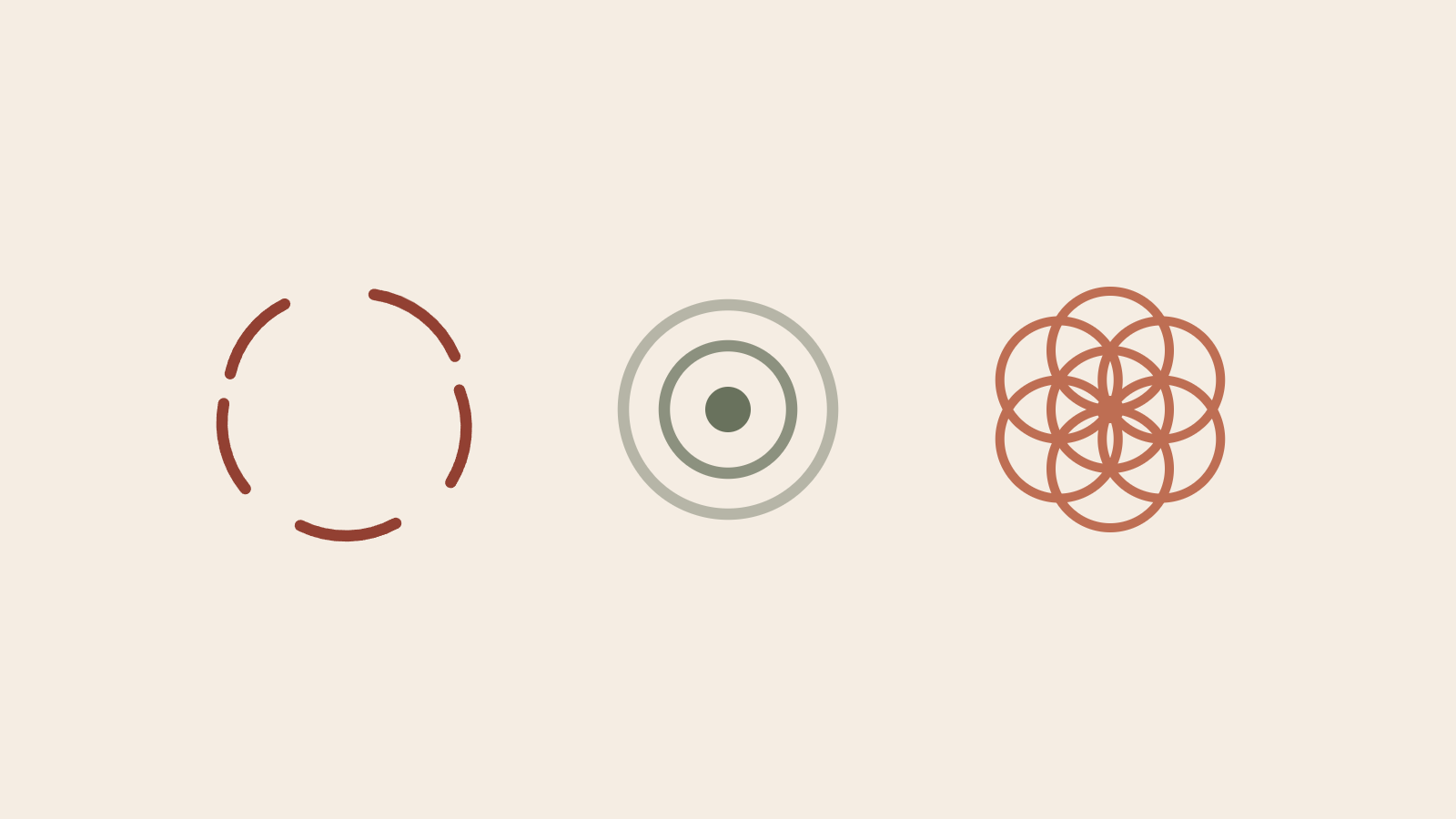
When we gave this philosophy a visual identity, we used one shape. A single circle in three states. First the circle breaking apart, the given shape coming undone. Then the pieces settling around a centre. Then the centre opening into petals.
One circle, because it is one process and one person. You are not a different self at each stage. And a circle rather than a line, because this is not something you complete once and file away. Life keeps handing you new conditioning. Practice keeps offering the way back. The arc repeats, each time from a deeper place. I have been at this since 2006 and I am still walking it.
Yoga is a light which once lit will never dim. The better your practice the brighter your flame.B.K.S. Iyengar
What this looks like over 28 days
Our 200 hour training runs for a full month, longer than most, and this arc is the reason. Deconstruction cannot be rushed and reconnection cannot be scheduled. The first days and weeks loosen the old structure through strong daily practice, philosophy that asks real questions, and a group small enough to be honest in. The middle of the training deepens into breath, meditation and the quieter practices where reconnection tends to happen. By the final week, students are teaching real classes, sharing what has genuinely taken root, and beginning to blossom in front of our eyes.
Graduation day at Samasti is not really a ceremony about a certificate. It is a room full of people who arrived as polished performances of themselves and are leaving as something far more interesting. Themselves.
Walk the arc yourself
The 200 hour teacher training in Bali is a 28 day immersion built around this philosophy. A small group, and residential packages that include everything.
Explore the 200H Training